You Are the Temple
I was honored to preach this message at the Living Hope International Ministries Men’s Conference 2026. Click here for the audio recording of my sermon.
But you will receive power when the Holy Spirit has come upon you, and you will be my witnesses in Jerusalem, in all Judea and Samaria, and to the ends of the earth.
-Acts 1:8
Exodus tells the story of how God led the Israelites out of slavery in Egypt to bring them to the Promised Land and make a covenant with them, that they would be his people and he would be their God. When God brought them out of slavery in Egypt, he brought them to a mountain in the Sinai Peninsula, called Mount Sinai.
On the third new moon after the Israelites had gone out of the land of Egypt, on that very day, they came into the wilderness of Sinai. 2 They journeyed from Rephidim, entered the wilderness of Sinai, and camped in the wilderness; Israel camped there in front of the mountain. 3 Then Moses went up to God; the LORD called to him from the mountain, “Thus you shall say to the house of Jacob and tell the Israelites: 4 ‘You have seen what I did to the Egyptians and how I bore you on eagles’ wings and brought you to myself.5 Now, therefore, if you obey my voice and keep my covenant, you shall be my treasured possession out of all the peoples. Indeed, the whole earth is mine, 6 but you shall be for me a priestly kingdom and a holy nation.’ These are the words that you shall speak to the Israelites.”
7 So Moses went, summoned the elders of the people, and set before them all these words that the LORD had commanded him. 8 The people all answered as one, “Everything that the LORD has spoken we will do.” Moses reported the words of the people to the LORD . 9 Then the LORD said to Moses, “I am going to come to you in a dense cloud, in order that the people may hear when I speak with you and so trust you ever after.”
When Moses had told the words of the people to the LORD, 10 the LORD said to Moses, “Go to the people and consecrate them today and tomorrow. Have them wash their clothes 11 and prepare for the third day, because on the third day the LORD will come down upon Mount Sinai in the sight of all the people.
16 On the morning of the third day there was thunder and lightning, as well as a thick cloud on the mountain and a blast of a trumpet so loud that all the people who were in the camp trembled.17 Moses brought the people out of the camp to meet God. They took their stand at the foot of the mountain. 18 Now all of Mount Sinai was wrapped in smoke, because the LORD had descended upon it in fire; the smoke went up like the smoke of a kiln, while the whole mountain shook violently. 19 As the blast of the trumpet grew louder and louder, Moses would speak and God would answer him in thunder. 20 When the LORD descended upon Mount Sinai, to the top of the mountain, the Lord summoned Moses to the top of the mountain, and Moses went up.
-Exodus 19:1-11, 16-20
This is this incredible scene where God’s presence comes down upon the mountain in this incredible manifestation of fire and smoke and cloud, not with a still small voice, but with a loud trumpet blast, and thunder, and the whole mountain shook.
Of course, God is invisible, but God made these visible signs manifest to prove to the Israelites that God is in this place. This mountain – which is just a large hunk of rock, really no different than any other mountain in the region geologically speaking – but it suddenly became very special, it suddenly became sacred ground, even to this day, this mountain is considered holy. It’s holy because it’s where God’s presence is, as manifest by the fire and the smoke and the cloud, everyone knew that God was in this place. And Moses went up and met God on the mountain.
And when Moses came down from that mountain, his face was radiant and glowing, so much so that they had to put a veil over his face because it was freaking people out. So there is this powerful manifestation of God’s presence on the mountain. The people encounter God there.
Now, as the Israelites were travelling in the wilderness, they set up what they called the Tabernacle. The Tabernacle was like a temple, but it was mobile. It was basically a large tent, it’s also called the Tent of Meeting, and they could set it up, worship God, and then move it from place to place as God instructed and as God led them throughout their journey in the wilderness to the Promised Land.
Turn to Exodus 40. This is the record of when they dedicated the Tabernacle for holy use. The presence of God filled the Tabernacle and made the Tabernacle holy.
We see this in Exodus 40, when they dedicate the Tabernacle and God shows up:
When they went into the tent of meeting and when they approached the altar, they washed as the LORD had commanded Moses. He set up the court around the tabernacle and the altar and put up the screen at the gate of the court. So Moses finished the work.
-Exodus 40:32-33
Now this work of building the Tabernacle was no small task. And there are numerous chapters detailing the construction of the Tabernacle and all of the craftsmanship that went into it, and all the materials it was made of – we don’t have time to get into all of that, but just understand that building the Tabernacle was a major undertaking for the people to do, especially doing so in the wilderness with limited resources.
Of course the Tabernacle was made of ordinary materials, there was some gold utensils and implements that were used, but for the most part it was wood and fabric and other ordinary materials, nothing particularly special about what the Tabernacle was made of, but when consecrated for holy use those ordinary objects became holy. Why did they become holy? Because God was there. Because God’s presence made the Tabernacle holy.
And we see God show up, and his presence manifest at the dedication of the Tabernacle, just like we saw at Sinai:
Then the cloud covered the tent of meeting, and the glory of the LORD filled the tabernacle.
-Exodus 40:34
Remember how there was a cloud on Sinai? We see this also at the Tabernacle. Just like God’s glory was manifest at Sinai, God’s glory filled the Tabernacle and it confirmed for the people that God was in this place, that God’s presence dwelled in this place.
Moses was not able to enter the tent of meeting. He was able to go up to Sinai, even though the mountain was literally on fire. But in this case, this visible glory of God – whatever that looked like, and we can’t even imagine it – this glory was so thick that they couldn’t even go into the tent.
Moses was not able to enter the tent of meeting because the cloud settled upon it, and the glory of the LORD filled the tabernacle. Whenever the cloud was taken up from the tabernacle, the Israelites would set out on each stage of their journey, but if the cloud was not taken up, then they did not set out until the day that it was taken up. For the cloud of the LORD was on the tabernacle by day, and fire was in the cloud by night, before the eyes of all the house of Israel at each stage of their journey.
-Exodus 40:35-38
Again, what are these elements, these manifestations that God used to confirm to the people that God was dwelling in this place? Cloud. Smoke. Fire. We saw it at Sinai. We saw it again when they dedicated the Tabernacle.
Now, this generation passed away. They wandered in the wilderness for 40 years because of their unbelief, and the next generation entered the Promised Land, not having seen God’s presence manifest at Sinai, not having been around for the dedication of the Tabernacle.
After entering the Promised Land, there was a period of Judges, and eventually the people demanded a king. And God said, “I am your king.” But the people wanted a human king like all the other nations had. So God gave them King Saul.
Now Saul did evil in the eyes of God, so God removed him as king and installed King David. David, despite some failures and some sins, was, overall a righteous king, a man after God’s own heart.
And David desired to build for God a house, a temple where people could worship God, could experience God, could encounter God.
Of course, God kind of laughed at this, he said, even the heavens of the heavens cannot contain me, and you want to build me a house?
And God said to David, “I know you want to build me a house, but I’m gonna build you a house.” And God made a covenant with David and promised him that from his household would come the Messiah, the king who would rule the world forever and make everything wrong with the world right. And we know that Messiah is Jesus.
But David’s heart was, “I want there to be a dedicated place where people can encounter God.”
In generations past, they had Sinai, they had the Tabernacle, they had these dedicated places that God had confirmed through these manifestations of fire and smoke and cloud, that his presence dwelled there, that people could worship and experience God in that holy place.
But the Tabernacle was only a temporary tent. David wanted to build a permanent Temple for God. But David, ultimately, did not finish the work of the Temple because he had too much blood on his hands from the many wars he had fought, so it was not appropriate for him to build a Temple.
But David’s son Solomon took up that work, and built the Temple. And picking up in the 2 Chronicles 5:
Thus all the work that Solomon did for the house of the LORD was finished. Solomon brought in the things that his father David had dedicated and stored the silver, the gold, and all the vessels in the treasuries of the house of God.
–2 Chronicles 5:1
Building the Temple was a massive amount of work, even far beyond the work of the Tabernacle. Again, it’s described in great detail in the Bible, we don’t have time to get into all of it, but the Temple was a massive structure with incredibly intricate craftsmanship. It took many years to build. Finally, when the work was finished, Solomon brought in the things that his father David had dedicated for the Temple. These are holy implements that God had ordained would be used in the worship of him. These are holy objects that signify God’s presence dwelling with his people.
Then Solomon assembled the elders of Israel and all the heads of the tribes, the leaders of the ancestral houses of the people of Israel, in Jerusalem, to bring up the ark of the covenant of the Lord out of the city of David, which is Zion. And all the Israelites assembled before the king at the festival that is in the seventh month. And all the elders of Israel came, and the Levites carried the ark. 5 So they brought up the ark, the tent of meeting, and all the holy vessels that were in the tent; the priests and the Levites brought them up.
–2 Chronicles 5:2-4
Again, this ark of the covenant, if you’re not familiar with it, this was a holy object that the Israelites had carried with them when they journeyed to the promised land. And on top of the ark were two golden angels called cherubim, and it says that the presence of God dwelled between the cherubim. And inside the ark were holy objects including the stone tablets inscribed with the Ten Commandments.
King Solomon and all the congregation of Israel, who had assembled before him, were before the ark, sacrificing so many sheep and oxen that they could not be numbered or counted. Then the priests brought the ark of the covenant of the LORD to its place, in the inner sanctuary of the house, in the most holy place, underneath the wings of the cherubim. For the cherubim spread out their wings over the place of the ark, so that the cherubim made a covering above the ark and its poles. The poles were so long that the ends of the poles were seen from the holy place in front of the inner sanctuary, but they could not be seen from outside; they are there to this day. There was nothing in the ark except the two tablets that Moses put there at Horeb, where the Lord made a covenant with the people of Israel when they came out of Egypt.
Now when the priests came out of the holy place (for all the priests who were present had sanctified themselves, without regard to their divisions), all the Levitical singers, Asaph, Heman, and Jeduthun, their sons and kindred, arrayed in fine linen, with cymbals, harps, and lyres, stood east of the altar with one hundred twenty priests who were trumpeters. It was the duty of the trumpeters and singers together to make themselves heard in unison in praise and thanksgiving to the Lord, and when the song was raised, with trumpets and cymbals and other musical instruments, in praise to the LORD,
“For he is good,
for his steadfast love endures forever,”the house, the house of the LORD, was filled with a cloud, so that the priests could not stand to minister because of the cloud, for the glory of the LORD filled the house of God.
-2 Chronicles 5:6-14
Can you imagine, after all the labor and the years of work that went into building this Temple, and they’re praying and crying out to God, “God, we want your presence, we want your presence to dwell in this place.” Can you imagine, after all the labor and all the work of building this Temple, finally, when this Temple is dedicated, the glory of God appears, and God confirms to his people through this manifestation of his glory, “This is where my presence dwells.”
And the glory was so thick that the priests couldn’t even minister because the glory was too intense. Does that sound familiar? This is what happened at the tabernacle. Moses couldn’t even go into the tent because the glory was so explosive. And that’s what happened here.
God’s presence came down to sanctify what had been ordinary gold, ordinary stone, ordinary wood, now had become this holy place where God’s presence dwells.
Now on chapter 6 King Solomon prays this amazing prayer. I don’t have time to read it. I highly recommend that you read it on your own time.
But we’ll pick up here in chapter 7:
God signified his presence not only with a cloud, not only with his glory whatever that looked like (we don’t know exactly what it looked like, but it was something so radiant that Moses’ face shined and they couldn’t even go into the Tabernacle or the Temple), but God also signified his presence with fire coming down.
When Solomon had ended his prayer, fire came down from heaven and consumed the burnt offering and the sacrifices, and the glory of the Lord filled the temple.
-2 Chronicles 7:1
Now, did fire always come down to consume burnt offering any time they offered burnt offerings to God?
No. There are other times when fire came down – for example, Elijah called down fire from heaven during his showdown with the prophets of Ba’al.
So yes, there were miraculous occurrences when fire literally came down from heaven. But fire did not always come down. There were many sacrifices that were just routine sacrifices, where the priests would light the fire themselves, as was their duty. I would posit that most of the sacrifices throughout the centuries were like that, fire did not come down.
But this first time, this first time the temple was dedicated, fire came down. God sent fire down at the dedication of the Temple, just to signify to his people, “I am God. I am here. I am in this place. This is where my presence dwells.”
2 The priests could not enter the house of the LORD because the glory of the LORD filled the Lord’s house. 3 When all the people of Israel saw the fire come down and the glory of the LORD on the temple, they bowed down on the pavement with their faces to the ground and worshiped and gave thanks to the LORD, saying,
“For he is good,
for his steadfast love endures forever.”-2 Chronicles 7:2-3
So, remember, this is a new generation. They were not around when the Tabernacle was dedicated. They were not round at Sinai. They grew up hearing the stories, hearing the legends, probably also singing songs about how God’s fire came down at Sinai, how God’s glory showed up at the Tabernacle, but they had never seen these manifestations of God’s presence with their own eyes.
So when the Temple is dedicated, again, after all the years of labor and work that went into it, they finally dedicate this Temple, and it’s almost a moment of suspense. Like, are the stories of our ancestors true? Like, is God going to show up again for his people like he did at Sinai? And everyone is waiting in great expectation. And then, all of a sudden, BOOM, fire comes down. And God confirms his covenant with his people. It’s as if God is saying to his people: “I am God. I am here. This is where my presence dwells.”
Now turn to Acts 1.
To set the scene, Jesus has been crucified. He’s been raised from the dead. He’s appeared to his disciples. And he’s about to be taken up into heaven to rule and reign as the King of kings at the right hand of God until God puts all things under his feet.
In the first book, Theophilus, I wrote about all that Jesus began to do and teach
-Acts 1:1
Now, the Book of Acts was written by the same guy who wrote the Book of Luke. So this is Luke writing, and he’s saying here, “Hey, in my first book, the Book of Luke, I told you all about the things that Jesus during this earthly ministry – his teachings, his crucifixion, his resurrection – and now I’m picking up the story here right before his ascension.”
until the day when he was taken up to heaven, after giving instructions through the Holy Spirit to the apostles whom he had chosen.
-Acts 1:2
Remember, the apostles were just ordinary people. Today we look at them as being these great apostles. But remember, they were literally fishermen. They were uneducated. Some of them may have been educated. At least one was a tax collector. But for the most part they were working class guys who worked ordinary trades. But when Jesus said, “Come, leave everything, follow me, and I will make you fishers of men” they literally left everything and followed him. It was their faith that made them great, not their education or wealth or talents.
So Jesus chose these 12 ordinary guys to be his apostles. And right before Jesus ascended, he gave instructions to these apostles he had chosen:
After his suffering he presented himself alive to them by many convincing proofs, appearing to them during forty days and speaking about the kingdom of God.
-Acts 1:3
We don’t have time to get into it, but over that period of 40 days – and 40 is a very important number in the Bible – Jesus appeared to many people in many different ways. There were so many incredible resurrection appearances that confirmed and proved that God had truly raised his Son from the dead.
And what does it say Jesus spoke about in these resurrection appearances? It says he spoke about the kingdom of God. The kingdom of God is the gospel that Jesus preached. The Bible says that everywhere Jesus went, he preached the same message: “Repent, for the Kingdom of God is at hand.” There’s this kingdom coming where everything wrong with the world will be made right. A kingdom with a righteous King – Jesus Christ – who will judge the world in righteousness and restore peace and justice to the earth and everything wrong with the world will be made right. This good news of the Kingdom of God is the message that Jesus preached everywhere he went, both before and after his resurrection.
While staying with them, he ordered them not to leave Jerusalem but to wait there for the promise of the Father. “This,” he said, “is what you have heard from me; for John baptized with water, but you will be baptized with the Holy Spirit not many days from now.”
So when they had come together, they asked him, “Lord, is this the time when you will restore the kingdom to Israel?”
-Acts 1:4-6
Now, this was not a stupid question. He had already died and been raised from the dead. He’s in Jerusalem. So they’re thinking, “This is it! This is the moment when God is going to put Jesus on the throne, as had been promised to David in the Old Testament, that a Messiah would come to rule the world forever and establish peace and justice on the earth forever”
He replied, “It is not for you to know the times or periods that the Father has set by his own authority.
-Acts 1:7
In other words, it was not yet time. It was not yet time for God’s Kingdom to fully come. There’s this gospel message that must go out first throughout the world to give people an opportunity to believe and repent and be accepted into this Kingdom before the end comes.
But you will receive power when the Holy Spirit has come upon you, and you will be my witnesses in Jerusalem, in all Judea and Samaria, and to the ends of the earth.”
-Acts 1:8
What does that mean? They’re in Jerusalem, right? So Jerusalem means, “right here where we are.”
Jerusalem was in the Roman province of Judea, so Judea means, “the surrounding region.”
Samaria was farther to the north, so Samaria means, “places that are farther away.”
And then, the ends of the earth, the farthest places of all.
So we see these concentric circles that the gospel message will pass through as it goes forth, starting in Jerusalem, and rippling outwards around the world.
To put it in our context, we could say that we are called to be his witnesses, here in the Capital Region, and in all of New York State, and in all of the United States, and to the ends of the earth.
“You will be my witnesses right here where you are… and a little bit farther away… and a little bit farther away… and so on all the way to the ends of the earth.”
You will bear witness of this great gospel message, this gospel of the Kingdom.
So how do they do that?
Well, it’s not by man’s strength. It’s not my trying to come up with cleverly devised sermons or arguments to spread the message.
This is by the power of the Spirit of God working through God’s people.
We see this in Acts 2. This passage may be familiar to you. I hope it’s familiar to you. It’s the record of the Day of Pentecost.
But I want us to read this record in light of these manifestations of God’s presence that we just saw at Sinai, at the dedication of the Tabernacle, and at the dedication of the Temple.
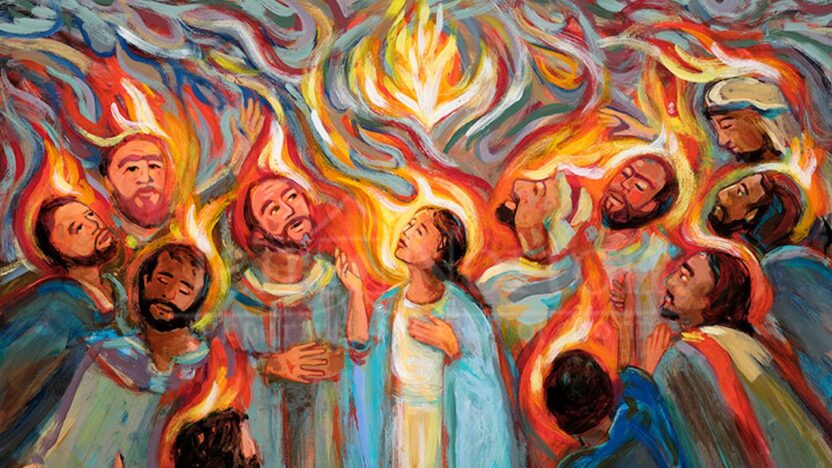
When the day of Pentecost had come, they were all together in one place. And suddenly from heaven there came a sound like the rush of a violent wind, and it filled the entire house where they were sitting.
-Acts 2:1-2
Rushing wind. Have we heard that before? Yes. Rushing wind. That’s the first sign.
Divided tongues, as of fire, appeared among them, and a tongue rested on each of them.
-Acts 1:3
Where else have we seen fire?
Sinai.
I think we saw it at the Tabernacle. We definitely saw smoke.
And I know we saw it at the Temple, right? Fire came down.
So there’s these tongues of fire, and they’re hearing this rushing wind. They’re looking around, like, “what is going on here?”
And these tongues of fire are coming down, and resting upon them.
All of them were filled with the Holy Spirit and began to speak in other languages, as the Spirit gave them ability.
-Acts 1:4
This is absolutely incredible. This day of Pentecost. When God’s Spirit filled his people, signified by these signs – just like when God’s presence came to Sinai and filled the Tabernacle and the Temple – just like that, God’s presence is now dwelling among and in his people.
So there’s this connection between the Temple back then, and today, his people.
Now, this is not speculation, okay? I want to share with you a few verses of scripture.
When Jesus visited the Temple before his crucifixion, the people were marveling at how incredible the Temple was, and Jesus, in Matthew 24:2, Mark 13:2, and Luke 19:44, Jesus said, “There’s a day coming, in this very generation, when not one stone will be left upon another.”
Jesus also said, in John 2:19, “Destroy this temple, and in three days I will raise it up.”
Now, these were key statements that they used to bring charges of blasphemy against Jesus and sentence him to death by crucifixion. Why? Because they thought he was speaking against the Temple.
But what they didn’t understand was, when Jesus said, “destroy this temple and in three days I will raise it up,” the temple was speaking about was his own body.
And when he said, “not one stone will be left upon another,” that was true. Approximately 40 years after Christ’s ascension – and 40 is a very important number in the Bible – the Temple in Jerusalem was destroyed by the Roman Empire.
If you go to the site where the Temple once stood, you will not find a temple there today. You will actually find a Muslim mosque on that site.
The Temple in Jerusalem was destroyed in 70 A.D. and for almost 2,000 years, it has never been rebuilt.
And, depending on your eschatology and your understanding of the End Times, there’s all kinds of speculation and debate as to whether or not that Temple in Jerusalem will ever be rebuilt.
I don’t know the answer to that.
But what I do know is this: There is a temple today.
There may not be a temple in Jerusalem. But there is a temple today. And I’m gonna show you that from the scriptures.
Remember how Jesus spoke of his own body as being a temple? In 1 Corinthians 6:19-20, we find these incredible verses:
Or do you not know that your body is a temple of the Holy Spirit within you, which you have from God, and that you are not your own? For you were bought with a price; therefore glorify God in your body.
-1 Corinthians 6:19-20
Now, when many people read these verses, they think it means: take care of your body, eat right, and exercise.
And the Bible says in 1 Timothy 4:8 that physical exercise is of some value, but spiritual, much more.
Of course, we should take care of our bodies, which includes eating right, exercising, and, also, abstaining from sexual immorality, which is actually the context of what the Apostle Paul is talking about here.
But I believe there is a spiritual truth here that is far greater than merely taking care of our bodies.
Turn to Ephesians chapter 2.
So then, you are no longer strangers and aliens, but you are fellow citizens with the saints and also members of the household of God, built upon the foundation of the apostles and prophets, with Christ Jesus himself as the cornerstone; in him the whole structure is joined together and grows into a holy temple in the Lord, in whom you also are built together spiritually into a dwelling place for God.
-Ephesians 2:19-22
Wow. This is one of my favorite passages in the entire Bible.
This passage identifies the church – not the building, but the people of God – as a holy temple in the Lord, and the dwelling place for God.
And here in verses 20 and 21, I just love the way this is worded… God’s temple today is built upon the foundation of the apostles and prophets, Christ Jesus himself as the cornerstone… the whole structure joined together… it doesn’t say that it is a temple… it says it grows into a temple.
Another translation says, “is growing into a holy temple.”
It’s an active process. It’s not finished yet. God’s temple is continually growing with each new member of the body of Christ added in as the gospel message goes forth to the ends of the earth.
What a beautiful picture!
Where is God’s temple today?
You won’t find it in Jerusalem.
God’s temple today is his people. His church. His body of believers. His ekklesia – those who are called out from the world and into God’s Kingdom.
We are the temple today. We are a dwelling place for God.
To really understand what this means, you need to dig into the Old Testament and really understand how important the Temple was to the ancient Jews. The Temple was everything. It was not only where God was worshipped and sin was forgiven, it was where people experience the presence of God.
It was a place where people encountered God. Where they saw God work. Where they saw manifestations that God is real. Where they heard from God.
That’s how the Temple functioned in the Old Testament.
God today works through his people to accomplish that.
In other words, do people encounter God when they encounter us?
Do they see God working through us? Do they experience his love through us? Do they encounter in us and in our testimony, the evidence that God is real?
Jesus said in Matthew 18:20, “where two or three are gathered in my name, I am there among them.”
When people join believers who are gathered together like we are gathered here, do they encounter Jesus in our midst? Do they encounter his love? His truth? His word? His message?
If we want to shine as lights in the world, we need to unlock the truth of what it means that we are the Temple today.
I want to look at just one more verse and then we’ll go back to Acts 1:8 to close out.
In John 14:2, Jesus said, “In my Father’s house there are many dwelling places. If it were not so, would I have told you that I go to prepare a place for you?”
Now, when most people read this, they just substitute “heaven” for “Father’s house.” They picture Jesus up in heaven, preparing a room or mansion (King James Version translates “dwelling places” as “mansion”) for you up in heaven, you know, he’s fluffing the pillows and getting it ready for you.
We know that’s not what Jesus is talking about here. We know from the scriptures that a day will come when the dead will be raised, and our final destiny isn’t heaven, but eternal life on a renewed and perfected earth.
And of course, Jesus is preparing a place for us in that world to come.
But I wonder, in light of what we just read, if there is also a deeper spiritual meaning here, when you consider the fact that throughout the scriptures, “Father’s house” or “house of God” usually refers to the temple. Consider also that what was traditionally translated “rooms” or “mansions” is more accurately translated “dwelling places” like we see here in the New Revised Standard Versions.
Of course, the temple is the place where God dwelled. But here, Jesus is saying, in my Father’s house are many dwelling places.
Could it be, that Jesus is preparing a place for us in God’s temple, that we would actually become a dwelling place for God?
That God would dwell in Christ and Christ would dwell in you, through the Holy Spirit.
I’m not 100% convinced of this interpretation of John 14:2. But I think in light of everything we’ve just been reading, it’s worthy of thought.
Certainly, I think there’s a much deeper level of meaning and significance here, than merely saying that Jesus is prepping us to go to heaven.
This is so much deeper when we truly understand what it means that we are the dwelling place of God’s Spirit.
And God’s Spirit empowers us to be his witnesses.
We didn’t have time to read it, but in the Book of Acts, when the Holy Spirit came at Pentecost, there was the rushing wind and the fire came down, and people started speaking in other languages as the Spirit empowered them to do so.
And people were freaked out and wondering what’s going on. Are these people drunk?
And Peter got up and said, “No, they’re not drunk. This is to fulfill what was written in the prophet Joel, that in the last days God would pour out his Spirit on all flesh, that young men would dream dreams and old men would see visions.”
And Peter preached this incredibly powerful sermon. If you haven’t read it, please take time today to do so. It’s incredible. His preaches this sermon and thousands of people believe.
This is the same Peter who – only a few weeks earlier – denied that he even knew Jesus because he was too embarrassed to admit to a servant girl that he knew Jesus, on the night Jesus was arrested.
How did this Peter go from being a wimp, to being this incredibly bold preacher on fire for Christ, witnessing to thousands?
One thing changed.
The power and presence of God filled his people through God’s Spirit, empowering God’s people to be witnesses for him.
We are empowered by that same Spirit. The same power that raised Christ from the dead lives in us.
So, when we’re looking at Acts 1:8 and thinking about what it means to be witnesses for Christ… it’s not about how smart you are or how skilled you are.
Moses could barely get 2 words out. God worked with him.
It’s God’s power and presence working through you.
Just like God filled the Temple, God can fill you and empower you to be that witness.
Now, there are many excuses that Satan uses to stop us from being witnesses.
Tell me if you’ve ever heard one of these excuses before:
“I just don’t have the gift of an evangelist.”
“I just don’t know enough… what if they ask me a question I can’t answer?”
“I’m not good at apologetics or debating people.”
Now, it’s true that not everyone has the gift of an evangelist.
Not everyone is knowledgeable enough to be a teacher.
Not everyone is skilled in apologetics.
And that’s okay.
We are not all called to the occupation of an evangelist.
We are not all called to be teachers.
We are not all called to be apologetics people.
We are all called to be witnesses.
Being a witness doesn’t mean teaching or preaching sermons.
Being a witness doesn’t mean winning debates or arguments.
The definition of a witness is simple: “One who testifies to what he has seen and heard.”
That’s it.
When you understand what it means to be a witness, you realize that evangelism is actually a lot simpler than most people think.
I think sometimes we make it too complicated.
We think we need to have every answer, that we have to study endlessly before we’re prepared enough to do it, that we have to win every debate.
But here’s the good news.
We’re not all called to debate.
Jesus didn’t say, “you will be my debaters.”
You don’t need to have all the answers.
You don’t need to be a great teacher.
You don’t need to know everything.
If someone asks you a question about the Bible that you don’t know the answer to, it’s okay to say that you don’t know.
We are not called to know everything, or teach everything, or win every argument.
All we are called to do is this: testify to what you have seen and heard.
Have you seen God work in your life?
Tell someone about it.
That’s it.
It’s simple.
And it’s not about arguing with people.
When you testify to what you have seen and heard… other people might not believe you, but, you’re speaking from experience.
God empowers his people today through the working of the Spirit to be witnesses.
God will work through us to reach the world with his truth and his love, to the uttermost parts of the earth.
We can be those witnesses today by his grace.
“This is what God has done for me.”
That’s it. That’s being a witness.
There are so many testimonies in this room of what God has done for you.
If we all got up here and shared them, we’d be here all night. And probably all day tomorrow as well.
God has delivered me from anxiety.
God has healed physical illnesses and issues.
He sent an angel to protect me.
I prayed for a wife for years and God answered my prayer in a miraculous way.
He delivered my wife from generational curses.
And I could go on and on about what God has done for me!!!
And I haven’t even mentioned the gift of eternal life and the hope of the Kingdom and everything wrong with the world made right… and that’s a pretty big deal!
See, this is what it means to be a witness.
We don’t need to make evangelism complicated.
God can work with you through his Spirit working in you, to empower you to share with others what God has done for you.
And we should share that with everyone.
Just like the sower and the seed in Matthew 13.
In that parable, the seed represents the gospel message. And the sower is spreading it everywhere: soil, rocks, roads, literally everywhere. He spreads it in places it can grow and places it can’t grow. He doesn’t care.
Some places it grows and some places it doesn’t, but the sower is not responsible for the seed growing. God makes the seed grow. The sower’s job is just to spread the seed.
If we want to shine as lights in the world:
• Understand how God worked through the Temple in the Old Testament
• Understand how God has raised up his people to be the Temple today
• Understand how God will empower you through his Spirit so people can encounter God through you and your testimony, just like people encountered God through the Temple in the Old Testament. We can have that same kind of power today to reach the world for Christ.
Recent Comments