Jesus Died for Your Sins

I was honored to preach this message at the Living Hope International Church on August 9, 2026. Click here for the video recording of my sermon.

Ever since the Russian invasion of Ukraine began, Christian missionaries have been active in Ukraine, often risking their lives to provide life-saving support to widows, orphans, and families in need. One of the efforts that has really ramped up recently, thanks to the work of organizations like the Ukrainian Bible Society, has been getting the Bible into the hands of Ukrainian soldiers on the front lines.

I want to share with you a true story of a Ukrainian soldier who received the gospel of John. He read it, and was struck that Christ claimed to be the only way to God. Jesus said in John 14:6 “I am the way and the truth and the life. No one comes to the Father except through me.”

One day, the young man’s squadron came under an intense Russian attack, and the man was mortally wounded. Medics rushed to his aid, but there was nothing that could be done – he was dying. With his final words, he pleaded with fellow soldiers to look to Jesus Christ. His last words were: “We all need to get right with God.”

In the weeks that followed, his squadron took the dying man’s words to heart. Each and every one of the men in his squadron read the Gospel of John and committed their lives to Christ. Within months, the entire squadron was baptized.

There is a saying that “there are no atheists in a foxhole.” Sooner or later, every person must ask themselves this question: “Am I right with God?” Even the atheist will eventually ask themselves if they are right with the God they don’t believe in. Am I right with God? For many of us, we try to distract ourselves from the question, to avoid thinking about it for as long as possible, until something like a terminal illness, a natural disaster, or God forbid a war, makes the question unavoidable.

To be made right with God is what we call atonement. We read about atonement here in 1 John 2. Now I’m gonna be reading today from the REV Bible, shoutout to Pastor Jerry Wierwille for his help translating this text. So I’m reading from the REV today, buf if you’re reading from any of the standard English Bibles, like the NRSV, NASB, or ESV, what I’m reading should match up very closely with your translation as well.

So we read in 1 John 2:

My little children, I write these things to you so that you will not sin. And if anyone sins, we have an advocate who intercedes for us with the Father—Jesus Christ, the Righteous One.  And he is the atoning sacrifice for our sins, and not for ours only, but also for the whole world.

What does “atoning sacrifice” mean?

Put simply, it’s how you are made right with God.

Atonement is defined as “reparation for an offense or injury.” In other words, a payment is made to make right that which was wrong.

Atonement is more than just forgiveness. Let’s say you steal something from me. If I say, “Eh, don’t worry about it. It’s no biggie.” – that’s forgiveness, but it’s not atonement. Atonement means a price is paid to make it right. So if you steal something from me, and then you come to me and say “I’m so sorry, I’m gonna make this right and pay you back 3 times what I took from you.” – that’s atonement.

When atonement happens, the parties that were once at odds with each other are reconciled. If I was mad at you for stealing from me, but you pay it back and make it right, now I’m no longer mad. Our relationship is restored. We go from being at odds with each other – enemies – to now being in right relationship with each other.

The word “atonement” was invented by Bible translator William Tyndale in the early 1530s. He was having trouble translating the Hebrew word kippur into English. Now, you may have heard of this word from the Jewish holiday Yom Kippur also known as the Day of Atonement, and we’re gonna talk about Yom Kippur more in a few minutes. Back in 1530 there wasn’t an English word that communicated the idea of kippur, so Tyndale made one.

He came up with the word by combining 3 words: at-one-ment. In other words, it’s the state of being at one with someone. If you’re “at one” with someone, it means you’re in right relationship with them. Atonement is how we come into a right relationship with God.

Now to understand what it means that Christ is the “atoning sacrifice” for our sins, we need to turn first to the Old Testament. Even though I’m preaching a sermon on how Jesus Christ died for your sins, we’re gonna spend a lot of time in the Old Testament today, and that’s because everything in the Old Testament points to Jesus. To understand the phrase “atoning sacrifice” you need to first understand that atonement is, and then, what a sacrifice is. These are concepts that are first communicated in the Old Testament, and understanding them first from a Hebrew Bible perspective will give us great insight when we finally turn to the New Testament.

So we’re gonna look at 3 concepts from the Old Testament and how each of them points to Jesus Christ as their final and ultimate fulfilment: the passover lamb, the sin offering, and the scapegoat.

First up, the passover lamb. Turn to Exodus 12.

To set the seen, the people of God are in slavery in Egypt, but God has a plan to rescue them out of slavery and bring them to the land he promised to their ancestors. So God raised up a man named Moses to go before Pharaoah the king of Egypt and say, “Let my people go!” Now, most of you know this story. Did Pharoah let the people go? No! Pharaoah did not let the people go.

So God brought 9 plagues upon Egypt, but after each plague, Pharaoah still did not let the people go. So finally, God brought the tenth and worst plague upon Egypt, and this is the plague that would finally convince Pharaoah to free God’s people from slavery.

God sent an angel of death to sweep over the land and kill the firstborn son of every family. But God instructed his people on what they needed to do to protect themselves from the angel of death.

Speak to all the congregation of Israel and say that on the tenth day of this month everyone among them must take a lamb according to their fathers’ houses, a lamb for a household.

And if the household is too little for a lamb, then he and his neighbor near his house are to take one according to the number of people; according to what everyone can eat you are to make your count for the lamb.

Your lamb must be without blemish, a male a year old. You are to take it from the sheep or from the goats,

and you are to keep it safe until the fourteenth day of the same month, and the whole assembly of the congregation of Israel is to slaughter it in the evening.

They must take some of the blood and put it on the two doorposts and on the lintel on the houses in which they will eat it.

-Exodus 12:3-7

And then there are instructions on how to eat it, but if you skip down to verse 12:

For on that night I will go through the land of Egypt and will strike down all the firstborn in the land of Egypt, both man and animal, and against all the gods of Egypt I will execute judgments. I am Yahweh.

The blood will be a sign for you on the houses where you are. And when I see the blood I will pass over you and no plague will be upon you to destroy you when I strike the land of Egypt.

This is why it’s called Passover. When the angel of death saw the blood of the lamb on the doorpost, it would pass overthat house and not strike anyone dead inside that house.

Now, you gotta admit this is weird. Obviously, God wants to strike down the Egyptians, but spare the Israelites. God could have achieved this any number of different ways. He could have said, “Hang a scarlet ribbon from your doorpost and when the angels sees the ribbon he will pass over you.”

Why did it need to be the blood of a lamb? Isn’t that weird?

Stay with me now. Rememeber, everything in the Old Testament symbolizes a future, final fulfilment that’s found in Jesus. So God was very intentional in making sure it would be the blood of a lamb on the doorpost. This has significance that will become more and more clear as we keep going. For now, just remember this simple fact and hold this in your mind:

 The blood of the lamb saved the people from death.

We’ll look next at the Guilt Offering. Turn to Leviticus chapter 4 verse 27.

And if one person of the common people sins unintentionally by doing one of the things that Yahweh his God has commanded not to be done, and he becomes guilty,

if his sin which he has sinned is made known to him, then he is to bring for his approach-offering a goat without blemish, a female, for his sin that he has sinned.

He is to lay his hand on the head of the sin offering and slaughter the sin offering at the place of the burnt offering.

The priest is to take some of its blood with his finger and put it on the horns of the altar of burnt offering. And all the rest of its blood he is to pour out at the base of the altar.   

He is to remove all its fat, just like the fat is removed from the sacrifice of peace offerings, and the priest is to burn it into smoke on the altar for a pleasing aroma to Yahweh; thus the priest will make atonement for him and he will be forgiven.

Now what is going on here?

At this point in the story, God has led his people out of slavery in Egypt, and they’re on their way to the promised land. But there is sin among the people. Before too long, the people build a golden calf and worship it as their god. And the people commit many other sins, doing what is wrong in God’s eyes. After everything God has done for them – the ten plagues, saving them from death on passover, parting the waters of the Red Sea so they can walk through on dry ground, providing manna to eat in the wilderness, a pillar of cloud by day and a pillar of fire by night, and many other miracles… the people still rebelled, and even wanted to abandon God entirely and return to slavery in Egypt.

This grieved God’s heart. After everything he did for them – love upon love, grace upon grace, miracle upon miracle – the people rejected God.

But God didn’t give up on his people. Because he is a loving and faithful and gracious and forgiving God, he made a way for his people to make amends for the wrongs they had done, and come back into a right relationship with God.

That way is called sacrifice. The idea is this: When a person sins, they take a goat – without spot or blemish – and they bring before the priest. They lay hands on this goat, and they kill it.

The Bible says that “the wages of sin is death.” But God in his grace allows the goat to die, instead of the man.

The goat dies. The man goes free. The payment is made. Right relationship with God is restored.

Why did God set it up this way?

Why did an animal need to die?

Why did it need to be so… bloody?

First of all, sacrifice shows us the seriousness of sin. I think as Christians we take sin too lightly. We believe that we’re forgiven in Christ, so we convince ourselves that sin is no big deal.

I think the Jews understood sin better than we do.

Can you imagine if, every time you sinned, you had to sacrifice an animal?

You would probably sin a lot less, right?

I want to zoom in on this phrase here “he is to lay his hand on the head of the sin offering, and slaughter the sin offering.”

Most scholars agree that this pronoun “he” does not refer to the priest. It refers to the man who sinned.

Can you imagine holding the head of this precious, adorable goat in your hands, then having to take the knife and slit its throat?

God instituted sacrifice as a vivid illustration that makes the seriousness of sin obvious in no uncertain terms. Sin always causes death – either your death, or the death of a substitute. Sin demands that a price be paid.

Now, many modern Jewish scholars, in an attempt to rationalize this seemingly barbaric ancient practice with modern sensibilities, have tried to lighten this, arguing that goat wasn’t really a substitutionary atonement, it was just a symbolic temple system that God gave so they wouldn’t follow the temple systems of the idolatrous nations surrounding them.   

But the consensus of ancient and medieval Jewish commentators contradicts this, arguing that the sacrifice was indeed substitutionary – the goat died in place of the man.

I want to read to you some of these Jewish commentaries:

Gersonides was a very influential Jewish rabbi who lived 1288-1344, and in his commentary on Leviticius, he writes: “For this reason the laying hands on the animal was [instituted] to indicate that it is as if he has removed those iniquities from upon himself and transferred them onto the head of that animal…”

Why did the man need to lay his hands on the head of the animal? Because it’s as if the guilt of the man is transferred to the animal. The man was guilty. The animal was innocent. The man deserved to die for his sins, but what should have happened to the man, happened to the animal instead. The animal died in place of the man. This is called substitutionary atonement.

Nachmanides was a very influential Jewish rabbi who lived 1194-1270, and he writes, “he has sinned against his God with his body and his soul and deserves to have his blood spilled and his body burned, were it not for the kindness of the Creator who took a substitute from him…”

Again, I think the meaning here is very clear. The consequence of sin is death, but a substitute dies in our place.

It’s as if you’re guilty of a crime, you’re convicted, you’re sentenced to death, you’re on death row awaiting your execution.

But then, all of a sudden, an innocent person steps in, and says, “Take me instead.”

They die. You go free.

That’s the concept here that God is establishing, way back in Levitcus. That’s grace.

And people think the Old Testament doesn’t have grace! But it does. Everything in the Old Testament points towards its ultimate fulfilment in the New Testament.

Last one. Ovadia ben Jacob Sforno. 1470-1550. He writes, “And he shall lean his hand upon his offering as one who prostrates himself and prays that his iniquity be upon the head of the sacrifice, as in the matter of the scapegoat that is sent away; and by this he will bring forth into some act of humility the thought of repentance which is in his heart, and it shall be accepted for him to atone for him.”

It’s important to point out that this was not a magic formula. Without faith in your heart and genuine repentance, simply going through the motions of a religious ritual has no benefit. 

Indeed, there are places in the Old Testament where God basically says, “I’m sick and tired of your sacrifices because you’re just going through the motions and not doing them with a genuine heart of repentance!”

God set up this system of sacrifice to help the people understand the seriousness of sin, to have humility, and to encourage them to repent.

Notice how Sforno references the scapegoat here. That brings us to the last thing in the Old Testament that I want to look at before we turn to the New. The scapegoat.

Turn to Leviticus 16:1.

And Yahweh said to Moses, “Tell Aaron your brother not to come at any time he wants to into the Holy place inside the veil that is in front of the atonement-cover that is on the ark, so that he does not die; for I will appear in the cloud over the atonement-cover.

Now just to give some content, God has already instructed the Israelites to build a tabernacle, which is a portable temple that travelled with them in the wilderness on their way to the promised land. Once they reached the promised land, eventually they build a permament temple. But whether tabernacle or temple, the basic structure was the same:
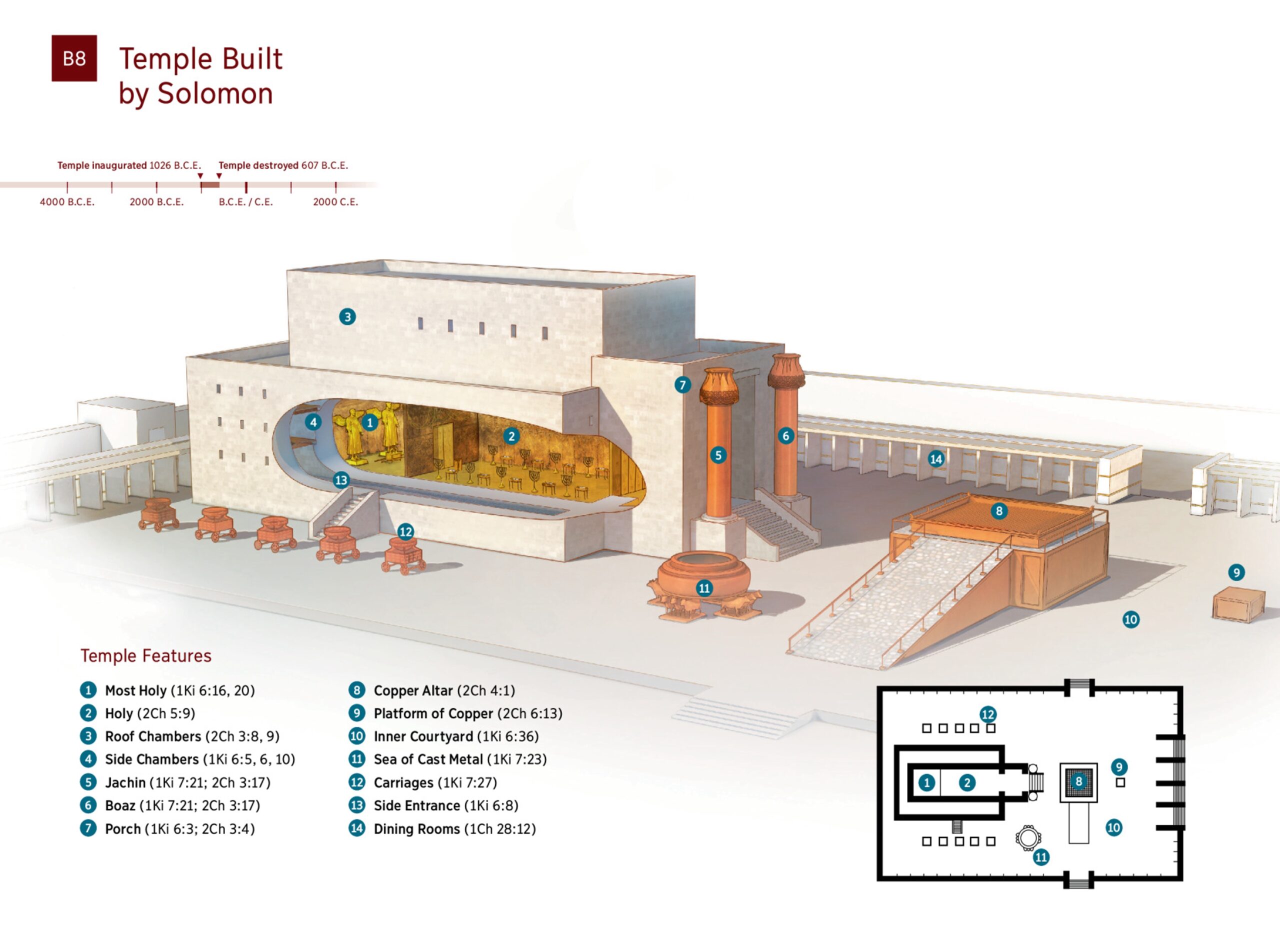
This is an artist’s rendering of the first Jewish temple.

You see outside the temple an altar on a raised platform. This is where animals were sacrified.

You see also a large basin of water. This is where priests would ritually wash themselves before entering the temple.

Inside the temple you have the Holy Place. This contained a golden lampstand called a menorah, a table with fresh bread called the bread of the presence, and the altar of incense.

Only the priests descended from Aaron could enter the Holy Place. It was magnificent. Beautifully decorated with gold and gemstones. Filled with the fragrance of bread and incense.

A thick curtain separated the Holy Place from the Most Holy Place. The Most Holy Place was the chamber that housed the Ark of the Covenant, where the very presence of God dwelled.

No one was allowed to enter the Most Holy Place except for the High Priest, and even he could only enter it once per year – on Yom Kippur, the Day of Atonement.

Because God is holy, and we are not, God gave meticulous instructions on how the high priest was to prepare himself for coming into God’s presence.

You just waltz into the Most Holy Place and say, “Yo, whatup God?”

No. If you are going to come into the presence of a holy God, you do it on his terms.

“Instead, this is how Aaron is to come into the Holy place: with a young bull for a sin offering and a ram for a burnt offering.

He is to put on the holy linen tunic and he is to have the linen undergarments upon his body, and is to put on the linen sash, and he is to be clothed with the linen turban. They are the holy garments. He is to bathe his body in water and put them on.

He is to take from the congregation of the children of Israel two male goats for a sin offering and one ram for a burnt offering.

“Aaron is to offer the bull for the sin offering that is for himself, and make atonement for himself and for his house.

He is to take the two male goats and set them before Yahweh at the entrance of the Tent of Meeting.

Aaron is to place lots upon the two goats: one lot “for Yahweh” and the other lot “for Azazel.”

Aaron is to bring the goat on which the lot came up for Yahweh and offer him as a sin offering.

But the goat on which the lot came up for Azazel is to be left standing alive before Yahweh to make atonement by means of it, to send it away to Azazel into the wilderness.

-Leviticus 16:3-10

This is where we get the word scapegoat.

scapegoat is defined as: “someone who is blamed for the wrongdoing of others.”

The goat did nothing wrong, but it bears the blame for the people’s sins.

Before sending this goat out into the wilderness, the high priest would place his hands upon the head of the goat, just like with the guilt offering, and he would confess to the goat all the sins of the people.

It’s as if the guilt of the people were being transferred onto this goat. And then when the goat is sent out into the wilderness, it carries away the sins of the people.

This is how atonement worked in the Old Testament.

But God always spoke through the prophets promising that one day a Messiah would come – one who would atone for all sin for all time, bringing all of humanity into a right relationship with God, making everything wrong with the world right.

How would he do this?

Turn to Isaiah 52 – 53:7

Behold, my servant will act wisely. He will be high and lifted up and exalted.

Just as many were appalled at you (his appearance was marred beyond human resemblance, and his form beyond that of human beings),

so he will sprinkle many nations. Kings will shut their mouths on account of him, for they will see what had not been told to them, and what they had not heard they will understand.

Who has believed what we have heard? To whom has the arm of Yahweh been revealed?

For he grows up before him as a young plant and as a root out of dry ground. He has no good looks or majesty. When we see him, there is no beauty that we should be attracted to him.

He is despised and rejected by people; a man of suffering, and one who knew sickness. Like one from whom men hide their faces, he is despised and we did not respect him.

Surely he has borne our sickness and has carried our suffering, yet we have considered him plagued, struck by God, and afflicted.

But he was pierced for our transgressions, was crushed for our iniquities. The punishment that brought us peace was on him, and by his wounds we are healed.

We all like sheep have gone astray. Everyone has turned to his own way, but Yahweh has laid on him the iniquity of us all.

He was oppressed, yet he suffered willingly, and he did not open his mouth. As a lamb that is led to the slaughter and as a sheep that before its shearers is mute, so he did not open his mouth.

and skip down to Isaiah 53:10.

Yet it was the will of Yahweh to crush him. He has caused him to suffer. If his soul makes itself a guilt offering, then he will see his seed. He will prolong his days, and the will of Yahweh will succeed in his hand.

See, everything in the Old Testament, from the Passover Lamb, to the guilt offering, to the scapegoat… it was all merely a shadow of the greater fulfilment to come. It all pointed towards the final and ultimate atonement accomplished by the Messiah, God’s servant and Son.

Just as the passover lamb saved God’s people from death, this Messiah saves us from death.

Just as the guilt offering atoned for sin, the Messiah offered up his own body as the lamb, and became a sin offering for all people for all time. A perfect man who did nothing wrong, died so that people who have done wrong – people like you and me – could be forgiven. He was pierced for our transgressions. Crushed for our iniquities.

Just as the priest would lay his hands on the scapegoat, and the sins of people would be transferred to the scapegoat, and carried by the goat off into the wilderness… just like that this Messiah carried our sins in his body. It says “he bore our sickness and carried our suffering.” And the Bible says that because of what this Messiah accomplished, our sins have been carried away “as far as the east is from the west.”

There is no longer animal sacrifice today. There is no longer any need for it. All of those things were merely shadows pointing towards the true, final, ultimate sacrifice that was to come: the sacrifice of Messiah.

One sacrifice to pay for all sins past, present, and future.

One sacrifice to bring the whole world into right relationship with God.

Who is this Messiah? Who is this perfect man? Who is this servant of God? This Savior?

Turn to John 1.

Before this great Messiah came, God prepared the way by sending a man named John. John baptized people for repetence, preparing the people for the Messiah who was coming.

And then, one day, John proclaimed the greatest that had ever been made.

“On the next day he saw Jesus coming to him, and said, “Behold the Lamb of God who takes away the sin of the world!

-John 1:29

This Lamb of God is Jesus Christ.

The only perfect man. A man who never sinned, but always did what was right. A man who devoted his life to healing the sick, giving sight to the blind, hearing to the deaf, feeding the hungry, setting captives free. A man who even raised the dead back to life.

This man turned the world upside down. The religious and political establishment hated him. This man was teaching people something fresh and powerful and exciting – he was teaching people how to know God personally, to call him Father, to be part of God’s family, to have not only the promise of eternal life, but purpose and joy and peace in this life as well.

They couldn’t find anything wrong with this man – he had never done anything wrong.

But they arrested him anyway. They brutally beat him and dragged him to sham trials where they made up all kinds of slander against him. They spat on him. They whipped him and beat him with rods. They pierced a crown of thorns into his head and mocked him.

They condemned him to death, but they didn’t have the authority to execute him without the approval of the Roman governor, Pontius Pilate. So they dragged him before Pilate for yet another trial.

Turn to Matthew 27:11-26.

Now Jesus stood before the governor, and the governor asked him, saying, “Are you the king of the Jews?” And Jesus said to him, “Yes, it is as you say.”

And when he was accused by the chief priests and elders, he gave no answer.

Then Pilate said to him, “Do you not hear how many things they are testifying against you?”

But he did not answer him with even one word, so the governor was greatly amazed.

Now at the Passover Feast, it was the governor’s custom to release to the crowd one prisoner whom they wanted.

And at that time they had a notorious prisoner called Barabbas.

Therefore when they were gathered together, Pilate said to them, “Whom do you want me to release to you? Barabbas, or Jesus who is called the Messiah?”

For he knew that they had handed him over because of envy.

And while he was sitting on the judgment seat, his wife sent to him, saying, “Have nothing to do with that righteous man, for today I have suffered many things in a dream because of him.”

Now the chief priests and the elders persuaded the crowd to ask for Barabbas and destroy Jesus.

But the governor answered and said to them, “Which of the two do you want me to release to you?” And they said, “Barabbas.”

Pilate said to them, “Then what do you want me to do with Jesus who is called Christ?” They all kept saying, “He should be crucified!”

But he said, “Why? What evil has he done?” But they shouted even louder, saying, “He should be crucified!”

So when Pilate saw that he was accomplishing nothing, but rather that a riot was starting, he took water, and washed his hands in front of the crowd, saying, “I am innocent of this man’s blood; see to it yourselves.”

And all the People answered and said, “His blood be on us and on our children.”

Then he released Barabbas to them, but he flogged Jesus and handed him over to be crucified.

The people chose Barabbas, a violent rebel. The man who had committed violence was set free, and the man who never sinned – who did no violence – died in his place. Even here, at the moment Jesus is condemned to die, we already see substitutionary atonement in action. Brabbas was on death row. He was the one who deserved to die. But he was set free, and Jesus died in his place.

Even more amazing is the fact that the name Barabbas literally means “son of the Father.”

Bar = Son

Abba = Father

Bar-abbas = Son of the Father

Jesus died so that sinners who don’t deserve it could become sons of God the Father.

And even as Jesus was on th his way to the cross, he was already setting free a sinner whose name means “son of the Father.”

That’s grace. That’s overwhelming, mindblowing grace.

So Barabbas went free. And Jesus went to the cross.

But first the Roman soldiders again brutally beat him and flogged him and whipped him.

Then Jesus was forced to carry a heavy wooden cross all the way outside the city and into the wilderness, just like the scapegoat.

All the way to a place called Golgotha, meaning the Place of the Skull. As one point, having been tortured all night long, Jesus was too weak to carry the cross any further, and a man named Simon of Cyrene carried it for him the rest of the way.

And reaching the Place of the Skull, they pierced his hands and feet, nailing his body to the cross, and they lifted him up.

Pierced for our transgressions. Woundeds for our iniquities.

And lest there be any confusion about the significance of what happened here… in John’s gospel he makes very clear that this was at Passover… the Passover lamb was to be slaughtered every year… that year, Jesus’s own body was the lamb… His blood over our homes saves us from death.

And those passing by were hurling insults at him, shaking their heads,

and saying, “The one who claimed he would destroy the temple and rebuild it in three days, save yourself. If you are the Son of God, come down from the cross.”

In the same way the chief priests also, with the experts in the law and elders, mocking him, said,

“He saved others but he is not able to save himself! He is the king of Israel; let him come down now from the cross, and we will believe in him.

He had confidence in God, let God rescue him now if he wants him, since he said ‘I am the Son of God.’”

 Even the rebels who were crucified with him were insulting him in the same way.

-Matthew 27:39-44

This whole time, Jesus just remained silent. Just as it said in Isaiah, “like a sheep before its shearers is silent, so he did not open his mouth.”

Now from the sixth hour darkness came over all the land until the ninth hour.i

And about the ninth hour Jesus cried with a loud voice, saying, “Eli, Eli, lama sabachthani?” (that is, “My God, my God, why have you forsaken me?”).j

And some of those standing there, when they heard this, said, “This man is calling for Elijah.”

And immediately one of them ran and took a sponge and filled it with wine vinegar and put it on a stick, and gave him a drink.

But the rest said, “Leave him alone. Let’s see if Elijah comes to save him.”

And Jesus, having cried out again with a loud voice, gave up his spirit.

And Look! The curtain of the sanctuary was torn in two from top to bottom, and the earth was shaken, and the rocks were split.

And the tombs were opened, and many bodies of the holy ones who had fallen asleep were raised

and coming out of the tombs after his resurrection they entered the holy city and appeared to many.

Now the centurion and those who were with him keeping watch over Jesus, when they saw the earthquake and the things that were happening, were greatly afraid, saying, “Truly this was the Son of God.”

Matthew 27:45-54

Your sin has been atoned for.

Carried away as far as the east is from the west.

The price has been paid.

It is finished.

The veil in the temple was torn!

Now all people can enter into the Holy of Holies – not just the high priest once a year.

Because of what Christ did, sinners like you and me are able to enter into the presence of God.

Now we can know God as our Father. Know him personally. Intimately.

We can be made right with God. Reconciled into his family.

For Christ did not enter into a holy sanctuary made with hands, which is a copy of the true things, but into heaven itself, now to appear before the face of God on our behalf.

Nor did he enter in order to offer himself over and over, like the high priest who enters into the Holy of Holies year after year with blood that is not his own.

since then it would have been necessary for him to have suffered over and over from the foundation of the world. But now he has been revealed once, at the end of the ages, to put away sin by the sacrifice of himself.

And just as it is appointed for a person to die one time, and after that comes the Judgment,

so Christ also, having been offered one time to take away the sins of many, will appear a second time, not to atone for sin, but to save those who eagerly wait for him.

Hebrews 9:24-28

So we go back to where we started. Remember those last words spoken by a dying soldier: “Are you right with God?”

If you can’t answer that with 100% certainty, you need atonement.

The good news of the gospel is this: atonement is available.

There is nothing you need to do to earn it. It’s already 100% paid for. 

It’s a free gift of salvation, but it wasn’t free. It was paid for with a heavy price. Paid for on the cross.

All you need to do is believe that Jesus died for your sins, and commit to follow him.

Make him the Lord of your life, and you can know God as your Father, and have assurance that you are saved and will have eternal life in God’s Kingdom.
  • 0

Hold Onto God’s Promises When All Seems Lost

I was honored to preach this sermon at Living Hope Community Church on March 19, 2023.

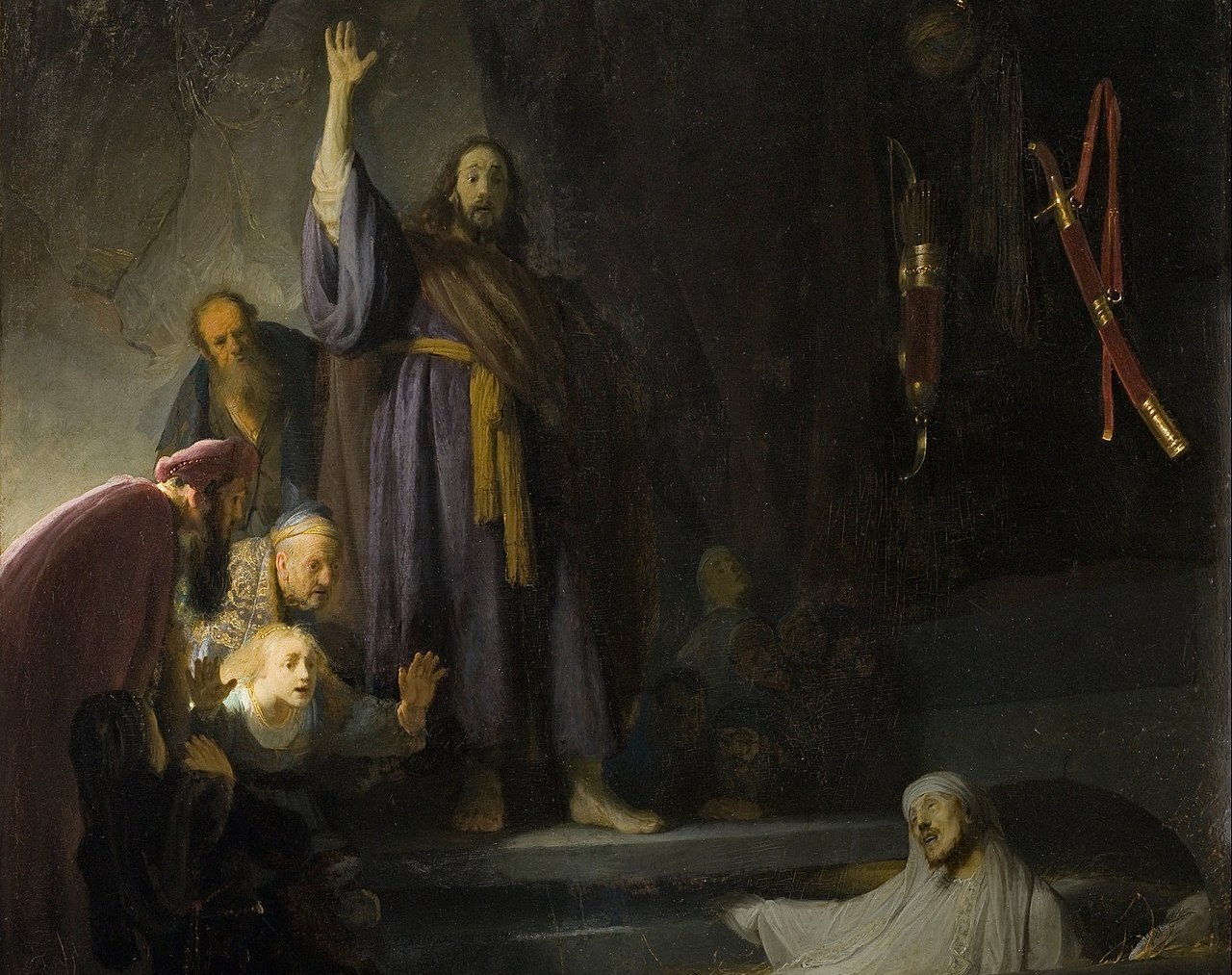
Rembrandt, “The Raising of Lazarus”

Now a certain man was sick: Lazarus of Bethany, the village of Mary and her sister Martha. And it was the Mary who anointed the Lord with ointment, and wiped His feet with her hair, whose brother Lazarus was sick. 

John 11:1-2

If you’re reading through the gospel of John for the first time, you might not remember this event that John is referencing here, of Mary anointing Jesus with ointment, and wiping his feet with her hair. That’s because it hasn’t happened yet. It happens in the next chapter. So what is the point of John referencing it here? John is emphasizing the special relationship between Jesus and Mary and Mary’s family. This is not a random family of strangers. There is deep love between this family and Jesus.

So the sisters sent word to Him, saying, “Lord, behold, he whom You love is sick.” But when Jesus heard this, He said, “This sickness is not meant for death, but is for the glory of God, so that the Son of God may be glorified by it.” (Now Jesus loved Martha and her sister, and Lazarus.) So when He heard that he was sick, He then stayed two days longer in the place where He was. 

John 11:3-6

Verse 6 is shocking. Verses 1-5 establish that Jesus loved Lazarus and that the sickness is not meant for death. The story is set up so that we expect to read: “so when he heard that he was sick, he immediately went and healed him.” But instead, we read: “so when he heard that he was sick, he then stayed two days longer in the place where he was.”

The key is v. 4: “This sickness is not meant for death” (another translation says “this sickness will not end in death”) “but it is for the glory of God, so that the Son of God may be glorified by it.”

Love is written all over this text. The affection with which Mary anointed Christ with ointment and wiped his feet with her hair – that’s love. Verse 3, “Lord, behold, he whom you love is sick.” Jesus loved Lazarus. Again, John tells us explicitly in verse 5, “Jesus loved Martha, and her sister, and Lazarus.”

Jesus didn’t immediately heal Lazarus. Instead, Jesus stayed two days longer in the place where he was. But that doesn’t mean Jesus didn’t love Lazarus. Jesus did love Lazarus. He had to trust the revelation he had received from God, that this sickness would not end in death. For Jesus to stay two more days where he was, he had to trust God with such faith that he would believe that even if Lazarus died, it wouldn’t be the end – God could raise him from the dead. How much faith is that?

The love of God and the glory of God. The two are not opposed to each other.

There is no greater love than to help another person see the glory of God. That is the ultimate love, and that is what happens in this story as it unfolds.

John Piper once said: “Love is doing whatever you have to do to help people see the glory of God as their supreme joy… The aim of love is to bring people to the fullest knowledge and the fullest enjoyment of the glory of God. Love means giving us what we need most. And what we need most is… a full and endless experience of the glory of God. Love means giving us what will bring us the fullest and longest joy. And what is that? What will give you full and eternal joy? The answer of this text is clear: a revelation to your soul of the glory of God — seeing, admiring, and marveling at and savoring the glory of God in Jesus Christ. Love is the longing that labors and suffers to enthrall others with what is infinitely and eternally satisfying: the glory of God. God is most glorified in us, when we are most satisfied in him.”

Right now, Martha, Mary, Lazarus, and even Jesus himself are about to go through some trials. Lazarus is sick, and as we will see, he’s about to die. So in this moment, it’s hard to see how God is working. At this point in the story, we don’t know what’s going to happen next. We don’t see the full picture yet, as God sees it. We see only the sickness and suffering of this moment. Every impulse within us says: “What are you doing, Jesus? You gotta go heal this guy right now! What are you waiting for?” But Jesus stayed where he was for two days.

Jesus said in John 5:30, “I do nothing on My own initiative, but I speak as the Father taught Me.”

He said in John 5:19, “The Son can do nothing of Himself, unless it is something He sees the Father doing; for whatever the Father does, these things the Son also does in the same way.”

Jesus always did the Father’s will. He too probably felt the human impulse to immediately heal Lazarus. But he stayed for two days because he had faith in what God was revealing to him – that God, who can see the bigger picture, was working something greater here. Jesus had to have great faith in order to persevere through this trial. He had to believe the promise God revealed in verse 4: the sickness will not end in death, but in the end, God’s love and his glory will be revealed. We will see throughout this story, Jesus is about to face ridicule and anger. He’s about to shed tears. He’s about to go through suffering. But it’s not in vain. God is working something greater here. Jesus had to trust in God through this trial and believe that in the end, God’s love and glory will be revealed. He had to believe that in the core of his being.

Is it any different for you and me? When we go through trials, we too must trust the promise of God revealed in Romans 8:28, that God works all things together for good for those who love God and are called according to his purpose. Do you believe that? Do you believe that even when you suffer? Do you believe that even when it’s hard?

If we want to overcome like Jesus, we too must trust in the promises of God in the midst of suffering. His word is truth. His promises will come to pass. Nothing else in this world will give us the strength to stand.

In the story we’re about to read, we’re going to see some suffering. We’re going to see some pain. We’re going to see tears shed. We’re going to see some moments where it feels hopeless. But don’t lose hope. Don’t lose faith.

As we read through this story, hold onto the promise of verse 4. The sickness will not end in death. God’s love and his glory will be revealed. To overcome like Jesus, we must hold onto the promises of God.

Then after this He said to the disciples, “Let’s go to Judea again.” The disciples said to Him, “Rabbi, the Jews were just now seeking to stone You, and yet You are going there again?” Jesus replied, “Are there not twelve hours in the day? If anyone walks during the day, he does not stumble, because he sees the light of this world. But if anyone walks during the night, he stumbles, because the light is not in him.” 

John 11:7-10

Jesus faced danger going to Bethany because, as seen in the previous chapter, the Jews were seeking to stone him to death. Verses 9-10 are mysterious. I’m not going to claim to fully understand them, but they might have something to do with John 9:4, “We must carry out the works of Him who sent Me as long as it is day; night is coming, when no one can work.”

Jesus knew what the prophets had foretold – that the Messiah would be pierced for our transgressions and crushed for our iniquities. He knew that he was going to be crucified and die for the sins of the world. But he also knew that it had to happen at the time God had appointed. Jesus was crucified at the time of Passover. There was incredible symbolism here. Just as the blood of the original Passover lamb saved the Israelites from the angel of death at the exodus from Egypt, so the blood of Jesus the sinless lamb of God saves us from death. It had to happen at the appointed time. Jesus operated on a divine timetable set by God the Father. Throughout the book of John, he uses the phase “My hour has not yet come.”

The disciples are saying to Jesus: “You can’t go to Judea because if you go to Judea right now, they’ll kill you.”

But Jesus is saying: “No, they won’t, because my hour has not yet come. God has appointed a time of day and a time of night. The time of day is the time that I am in the world. The time of night is the time of my crucifixion. I will go to Judea with confidence because I trust that God won’t allow me to be killed until the proper time.”

This He said, and after this He said to them, “Our friend Lazarus has fallen asleep; but I am going so that I may awaken him from sleep.” The disciples then said to Him, “Lord, if he has fallen asleep, he will come out of it.” Now Jesus had spoken of his death, but they thought that He was speaking about actual sleep. So Jesus then said to them plainly, “Lazarus died, and I am glad for your sakes that I was not there, so that you may believe; but let’s go to him.”

John 11:11-15

Jesus understood that death is sleep – that is, the dead are at rest until the resurrection of the dead when they will awake to face the final judgement. “Lazarus died, and I am glad for your sakes that I was not there, so that you may believe.” Isn’t this puzzling? Lazarus died, and I am glad I was not there? His dear friend whom he loves has died, and he’s glad? How does that make sense?

Look carefully here. He’s glad “for your sakes, that you may be believe.” Again, love is doing whatever needs to be done for someone to see and be satisfied with the glory of God. Despite the death, despite the grief of knowing his dearly beloved friend has died, Jesus can be glad in this moment because he knows beyond the shadow of a doubt that death is not the end of the story and that God’s glory is about to be revealed – and through that, the disciples will see and will believe. And that is something to be glad about, if we have enough faith to believe it!

See, even though Lazarus has died, Jesus is still holding onto the promise of verse 4: “this sickness will not end in death, but the glory of God is going to be revealed” That is the promise that Jesus received from God. And if it’s really true that the sickness won’t end in death, then it logically follows that even if Lazarus dies, well, God will need to raise him from the dead!

What kind of faith is that? I think if any of us had a friend who was sick, and we felt like God was speaking to us and promising us that they would be healed, and then they died, we would say, “Well, I guess I was wrong.” There is a finality to death that none of us dare to question.

But Jesus doesn’t go there. Jesus has received this word from God that the sickness won’t end in death. So even in the face of death, Jesus continues to believe the promise of God. He believes to the core of his being that God, who cannot lie, will always keep his promises, even if it means raising the dead.

You want to know how Jesus overcame? This is how Jesus overcame. With this kind of faith. Incredible faith. Unimaginable faith. Faith so strong that even in the face of death he could be glad because knew death wasn’t the end and God’s glory was imminent.

Therefore Thomas, who was called Didymus, said to his fellow disciples, “Let’s also go, so that we may die with Him!”

John 11:16

Jesus is facing danger going to Bethany because the Jews are seeking to stone him. He has confidence that God won’t allow him to be killed until the proper time. But the disciples don’t have this much faith. They are fearful of the Jews who are seeking to kill Jesus, and they see going to Bethany right now as a suicide mission. They don’t have as much faith as Jesus has, so they are afraid. Nevertheless, they still follow him.

So when Jesus came, He found that he had already been in the tomb four days. Now Bethany was near Jerusalem, about fifteen stadia away; and many of the Jews had come to Martha and Mary, to console them about their brother. So then Martha, when she heard that Jesus was coming, went to meet Him, but Mary stayed in the house. Martha then said to Jesus, “Lord, if You had been here, my brother would not have died. Even now I know that whatever You ask of God, God will give You.” Jesus said to her, “Your brother will rise from the dead.” Martha said to Him, “I know that he will rise in the resurrection on the last day.”

John 11:17-24

Martha believed in the future resurrection of the dead. She correctly understood that the dead are asleep, waiting for the resurrection, and on the last day, when the Messiah comes to judge the world and make everything wrong with the world right, on that day the dead will rise. Those who trust in Christ will rise and meet him face to face, and be with him forever on a renewed and perfected earth where there is no more death, or sorrow, or tears, or war, or sin. This is the gospel that Jesus preached. The gospel of the kingdom of God. Everything wrong with the world will be made right. Martha understood! She gets it! She gets the gospel message!

But notice how Jesus responds here. I would expect him to commend her, to say, “Blessed are you, Martha, for you understand the kingdom of God! Isn’t this good news! Yes! Lazarus will rise again!”

But that’s not what Jesus says. Look at verses 25-26.

Jesus said to her, “I am the resurrection and the life; the one who believes in Me will live, even if he dies, and everyone who lives and believes in Me will never die. Do you believe this?” 

John 11:25-26

Martha believed the gospel of the kingdom. She had faith in a future resurrection of the dead. But Jesus took it a step further. He said: “I AM that resurrection, and I showed up right here and right now!”

Christ is the resurrection. He is the king who will raise the dead. All power and authority have been given to him by God. God has put all things under his feet. As it says in Revelation 1:18, he holds the keys to death and the grave in his hand.

So notice how Jesus connects Lazarus’ resurrection to your resurrection. It would already be an extraordinary thing for Jesus to claim that he could raise Lazarus from the dead. But Jesus takes it one step further. Not only is Jesus able to raise Lazarus from the dead by the power and authority that God has given him – he is able to raise you from the dead by that same power. He is able to call Lazarus out of the grave by name, and he is able to call you out of the grave by name.

Whoever believes in him, even if he dies, he will live again. Jesus is telling Martha that if she believes, the same resurrection from the dead that can happen to Lazarus can also happen to her, and to all who believe.

She said to Him, “Yes, Lord; I have come to believe that You are the Christ, the Son of God, and He who comes into the world.”

When she had said this, she left and called Mary her sister, saying secretly, “The Teacher is here and is calling for you.” And when she heard this, she got up quickly and came to Him.

Now Jesus had not yet come into the village, but was still at the place where Martha met Him. Then the Jews who were with her in the house and were consoling her, when they saw that Mary had gotten up quickly and left, they followed her, thinking that she was going to the tomb to weep there. So when Mary came to the place where Jesus was, she saw Him and fell at His feet, saying to Him, “Lord, if You had been here, my brother would not have died.” Therefore when Jesus saw her weeping, and the Jews who came with her also weeping, He was deeply moved in spirit and was troubled, and He said, “Where have you laid him?” They said to Him, “Lord, come and see.” Jesus wept. So the Jews were saying, “See how He loved him!” But some of them said, “Could this man, who opened the eyes of the man who was blind, not have also kept this man from dying?”

John 11:27-37

Jesus wept.

The shortest verse in the Bible, but one of the most profound.

In understanding why Jesus wept, commentators often say that even though he knew Lazarus would be raised from the dead, he was still overwhelmed by sadness because of Lazarus’ death. Perhaps that is true. But I think there is another, more obvious reason why Jesus wept.

“If you had been here, he wouldn’t have died.”

“Couldn’t this man have kept him from dying?”

Three times Jesus is unfairly blamed for Lazarus’ death – first by Martha, then by Mary, then by the Jews.

They’re essentially saying to him: “This is your fault, Jesus. You’re the reason he died.”

Have you ever been accused like that? Jesus has. He’s walked in your shoes. He’s felt the same feelings that you feel. He gets you.

Isaiah 53:3 says, “He was despised and forsaken of men, a man of sorrows and acquainted with grief.”

Jesus knew sadness.

John 11:35 is not the only time when Jesus wept.

In Luke 19, Jesus wept over Jerusalem because he understood the destruction that was going to come upon the city at the hands of the Romans.

This weeping was not just tearing up a little bit or shedding a tear. The Greek word translated “wept” in Luke 19 means “to wail loudly.”

Jesus knows what it is to feel overwhelming despair.

He offered up both prayers and pleas with loud crying and tears to the One able to save Him from death, and He was heard because of His devout behavior. Although He was a Son, He learned obedience from the things which He suffered.

Hebrews 5:7-8

Jesus wept.

The weeping here in John 11 is a different kind of sadness than in Luke 19. The Greek word translated “wept” in John 11:35 means “to cry silently.”

Scripture doesn’t tell us exactly what Jesus wept, and I don’t want to read into it, but I think the text implies that it was more than mere sadness that Lazarus had died. Remember, Jesus clung to the promise of verse 4: the sickness won’t end in death, but the glory of God is going to be revealed. He also knew, before he went to Bethany, that Lazarus was already dead. It’s not like he showed up and was shocked to discover that Lazarus was dead. He knew he was already dead, but he still believed it won’t end in death. So clearly, Jesus had to hold onto the promise of verse 4 and believe that God could raise the dead, otherwise, he wouldn’t have even come.

But the people don’t share his faith. They lack faith in this moment. They are filled with grief and anger. They are looking for someone to blame.

Verse 33 says Jesus “was deeply moved in spirit.” This translation is pretty tame. The Greek word here means “to be moved with anger, to admonish sternly, to snort with rage like an angry horse.”

Verse 33 also says that Jesus “was troubled.” Again, this is a very tame translation. The Greek word means “to be restless, stirred up, agitated.” It’s the same word used in John 5:7 to describe the waters of the pool of Bethesda being stirred up.

I don’t think it’s reading into the text, to say that Jesus felt something here beyond just sadness.

He is being blamed for Lazarus’ death. The people have no faith in his ability to rectify this situation.

He is facing the full force of their rage, criticism, and insult.

Jesus wept.

Jesus wasn’t a stoic. Jesus felt his emotions. Jesus wrestled with his emotions and worked through them. He wasn’t controlled by them, but he didn’t suppress them either. He felt them and expressed them to God.

So Jesus, again being deeply moved within, came to the tomb. Now it was a cave, and a stone was lying against it. Jesus said, “Remove the stone.” Martha, the sister of the deceased, said to Him, “Lord, by this time there will be a stench, for he has been dead four days.” Jesus said to her, “Did I not say to you that if you believe, you will see the glory of God?” 

John 11:38-40

Remember the promise of verse 4: “This sickness is not meant for death, but is for the glory of God, so that the Son of God may be glorified by it.”

So they removed the stone. And Jesus raised His eyes, and said, “Father, I thank You that You have heard Me. But I knew that You always hear Me; nevertheless, because of the people standing around I said it, so that they may believe that You sent Me.” 

John 11:41-42

Jesus always gave God the glory. He had total confidence that God would hear him. Nevertheless, he thanked God for hearing him, and he thanked God out loud in the presence of other people, in order to publicly glorify God and give God the credit for the miracle that was about to be performed.

There are seven miracles that Jesus performs in the gospel of John before his passion. This is the seventh and the greatest. He wants to make sure that God gets all the credit for it. Jesus always gave God the glory.

And when He had said these things, He cried out with a loud voice, “Lazarus, come out!” Out came the man who had died, bound hand and foot with wrappings, and his face was wrapped around with a cloth. Jesus said to them, “Unbind him, and let him go.”

John 11:43-44

The promise of verse 4 has come to pass.

The sickness did not end in death.

God’s glory was revealed.

Death defeated. Wrong made right. Doubt turned to faith. Hopelessness to hope. Mourning to joy.

This is a foretaste of the kingdom of God. It’s not just something that happened. It’s a picture of what’s to come – for you and for me.

Just as Jesus called Lazarus out of the grave, if you believe, he’ll call you out of the grave.

One day, Jesus will return to rule the world, to bring peace and justice to the earth, and make everything wrong with the world right.

For the Lord Himself will descend from heaven with a shout, with the voice of the archangel and with the trumpet of God, and the dead in Christ will rise first. Then we who are alive, who remain, will be caught up together with them in the clouds to meet the Lord in the air, and so we will always be with the Lord. Therefore, comfort one another with these words.

1 Thessalonians 4:16-18

And I heard a loud voice from the throne, saying, “Behold, the tabernacle of God is among the people, and He will dwell among them, and they shall be His people, and God Himself will be among them and He will wipe away every tear from their eyes; and there will no longer be any death; there will no longer be any mourning, or crying, or pain; the first things have passed away.”

Revelation 21:3-4

Lazarus was in the grave for four days. Between the time that he died and the time that he rose, his family mourned. They felt devastated, hopeless, even angry. They criticized Jesus for not coming sooner. It was impossible for them, during those four days, to see how God was working, why God would allow this, how God could possibly work this out for their good and for his glory.

We go through similar experiences in life.

In life, there are times when we can’t see how God is working.

We have such limited perspective. We don’t see the end from the beginning, like God does.

The Apostle Paul said that right now, we see through a mirror dimly, but then we will see face to face; right now we know only in part, but then we will know fully.

But be encouraged by this truth: The word of God is true, even when we can’t see it.

The promises of God are true, even when we can’t imagine how they’re possibly going to come to pass.

Do you have faith to say, “God, I don’t know how you’re possibly going to work this out for my good and for your glory, but I’m still believing that you are because it’s written in your word in Romans 8:28 and your word never fails. God who cannot lie has spoken it and your promises never fail. So I believe that you’re working even when I can’t see it.”

Do you have that kind of faith this morning?

If you do, you can overcome anything.

To overcome like Jesus, we need to hold onto the promises of God.

  • 0

The God of the Weak and Lowly

I was honored to deliver this Christmas sermon at Living Hope Community Church on December 18, 2022.

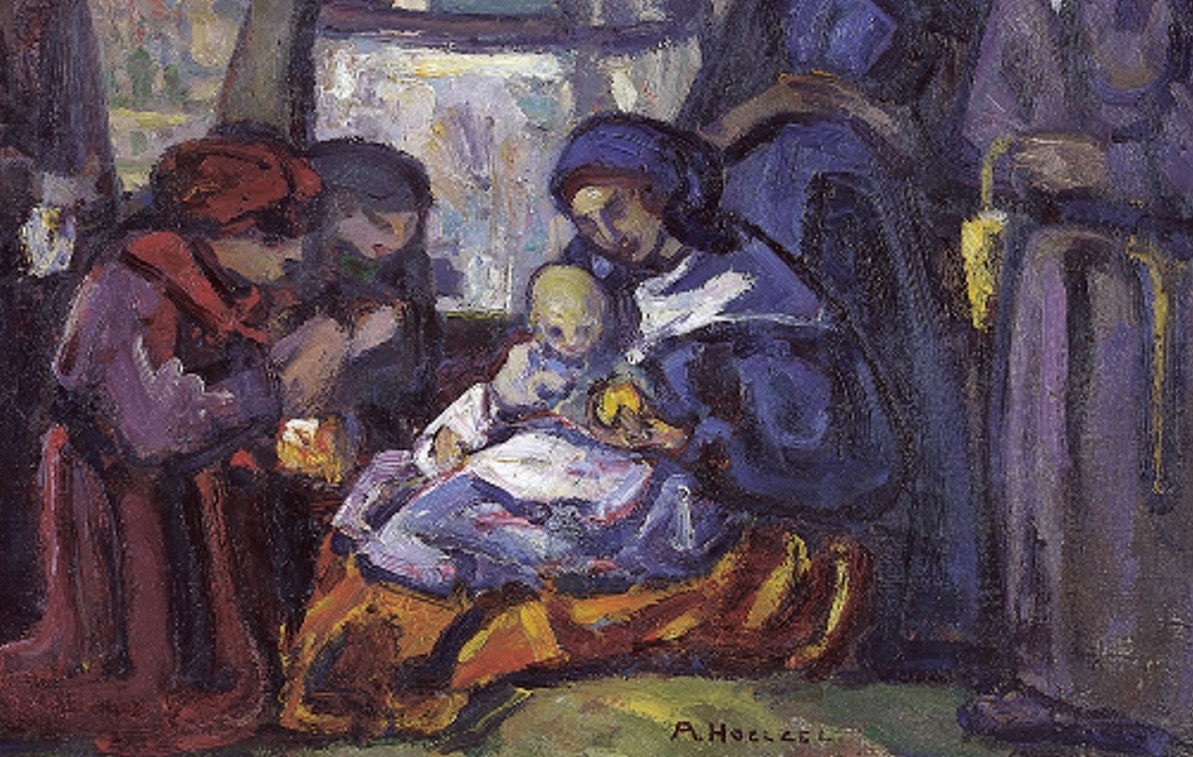
Adolf Hölzel, Adoration

In those days a decree went out from Caesar Augustus that all the world should be registered. This was the first registration and was taken while Quirinius was governor of Syria. All went to their own towns to be registered. Joseph also went from the town of Nazareth in Galilee to Judea, to the city of David called Bethlehem, because he was descended from the house and family of David. He went to be registered with Mary, to whom he was engaged and who was expecting a child. While they were there, the time came for her to deliver her child. And she gave birth to her firstborn son and wrapped him in bands of cloth and laid him in a manger, because there was no place in the guest room.

Luke 2:1-7

What was this event, which Luke records with such simplicity?

A woman of humble means, wrapping her child in simple bands of cloth, laying him in a feeding trough for animals, because there was no guest room available.

There was no fanfare. There was no royal pageantry. There was no pomp and circumstance.

An estimated 385,000 babies are born every day.

This event – the birth of a single baby, in a seemingly insignificant region of the world, laid to rest in the humblest of circumstances – would, from a human perspective, have no obvious significance, and would not be expected to change the world or the course of history.

And yet, from God’s perspective, this was the most important day. And for those who believe, this day changed the universe, and has the power to change our lives forever.

It was, first and foremost, a real day. Unlike some religious figures such as the Buddha – whose births are unclear exactly when or, even if, they happened – this day is authenticated in history. A day attested to by historians – Christian, Jewish, and Roman. A real day, at a real time in history, when Caesar Augustus was Emperor of Rome and when Quirinius was governor of Syria.

A real place – Bethlehem. Here, Luke refers to Bethlehem by its traditional title “city of David” because of its historical ties to the ancient Jewish king. However, at this time in history, this “city” was only a small village. According to biblical scholar William Barclay, at the time of the birth of Jesus, the population of Bethlehem may have been as few as 200-300 people. John, in his gospel, uses the Greek word “ko-may” to refer to Bethlehem, a word meaning a small hamlet or village.

Bethlehem in 1698. Sketch by Cornelis de Bruijn.

And what of Nazareth, the town from which Mary and Joseph travelled, and in which their child would grow up? Nazareth was not much larger – perhaps 500 people according to some estimates. It was, so to speak, “in the boonies” – so much so that the people of that day asked, as recorded in John 1:46, “Can anything good come from Nazareth?”

And the region of Galilee, such a backwater that the people of that day asked, as recorded in John chapter 7, “How can the Christ come from Galilee? No prophet comes out of Galilee.”

From a human perspective, this was a seemingly insignificant day, a seemingly insignificant place, a seemingly insignificant event.

And yet, this was precisely the day, precisely the place, precisely the event that God chose to change our lives, to change history, to change the world, to change the cosmos and the entire created order.

It was a day the prophets had spoken of for thousands of years.

It was a day that Abraham envisioned and rejoiced to see.

It was a day foretold since the Garden of Eden.

The rise and fall of empires, the decrees of governors, and even the appearance of the stars in the sky were all guided by the hand of God, so that this day would come.

Moses told the people of Israel:

The Lord your God will raise up for you a prophet like me from among your own people; you shall heed such a prophet

Deuteronomy 18:15

Likewise the prophets:

But you, O Bethlehem of Ephrathah, who are one of the little clans of Judah, from you shall come forth for me one who is to rule in Israel, whose origin is from of old, from ancient days.

Micah 5:2

For a child has been born for us, a son given to us; authority rests upon his shoulders, and he is named Wonderful Counselor, Mighty God, Everlasting Father, Prince of Peace. Great will be his authority, and there shall be endless peace for the throne of David and his kingdom. He will establish and uphold it with justice and with righteousness from this time onward and forevermore. The zeal of the Lord of hosts will do this.

Isaiah 9:6-7

A shoot shall come out from the stump of Jesse, and a branch shall grow out of his roots. The spirit of the Lord shall rest on him, the spirit of wisdom and understanding, the spirit of counsel and might, the spirit of knowledge and the fear of the Lord. His delight shall be in the fear of the Lord. He shall not judge by what his eyes see or decide by what his ears hear, but with righteousness he shall judge for the poor and decide with equity for the oppressed of the earth; he shall strike the earth with the rod of his mouth, and with the breath of his lips he shall kill the wicked. Righteousness shall be the belt around his waist and faithfulness the belt around his loins.

Isaiah 11:1-5

These are just a few of the many prophecies of Christ found in the Old Testament. In fact, every book of the Old Testament points to Christ in some way. The Jews looked with eager expectation for a Messiah who would liberate their kingdom from oppression. A man who would be both priest, prophet, and king. One who would finally establish peace, justice, and righteousness on the earth.

How did the people expect this great Messiah to come?

Surely, he would be a powerful warrior. Surely, he would come on a mighty war horse, commanding enormous armies.

Yet God, in his subversive gentleness, chose to undermine empire and defeat the powers of evil through the meekness of a tiny baby laid in a manger.

Here is my servant, whom I uphold, my chosen, in whom my soul delights; I have put my spirit upon him; he will bring forth justice to the nations. He will not cry out or lift up his voice or make it heard in the street; a bruised reed he will not break, and a dimly burning wick he will not quench; he will faithfully bring forth justice. He will not grow faint or be crushed until he has established justice in the earth, and the coastlands wait for his teaching.

Isaiah 42:1-4

God could have brought his Son into the world any way he wanted.

How great is our God, that of all the ways he could have done it, he chose to work through a humble, ordinary woman named Mary?

Can you imagine the awe that Mary must have experienced when the angel told her that from her would come the Messiah, the one who would be priest, prophet, and king – the one who would save people from their sins?

Can you imagine her awe when she realized that of all the people who ever lived and ever will live, she was the one would bring the Son of God into the world?

Why Mary?

It was not because there was anything extraordinary about her – she was an ordinary woman!

But, she had extraordinary faith and obedience to God’s word.

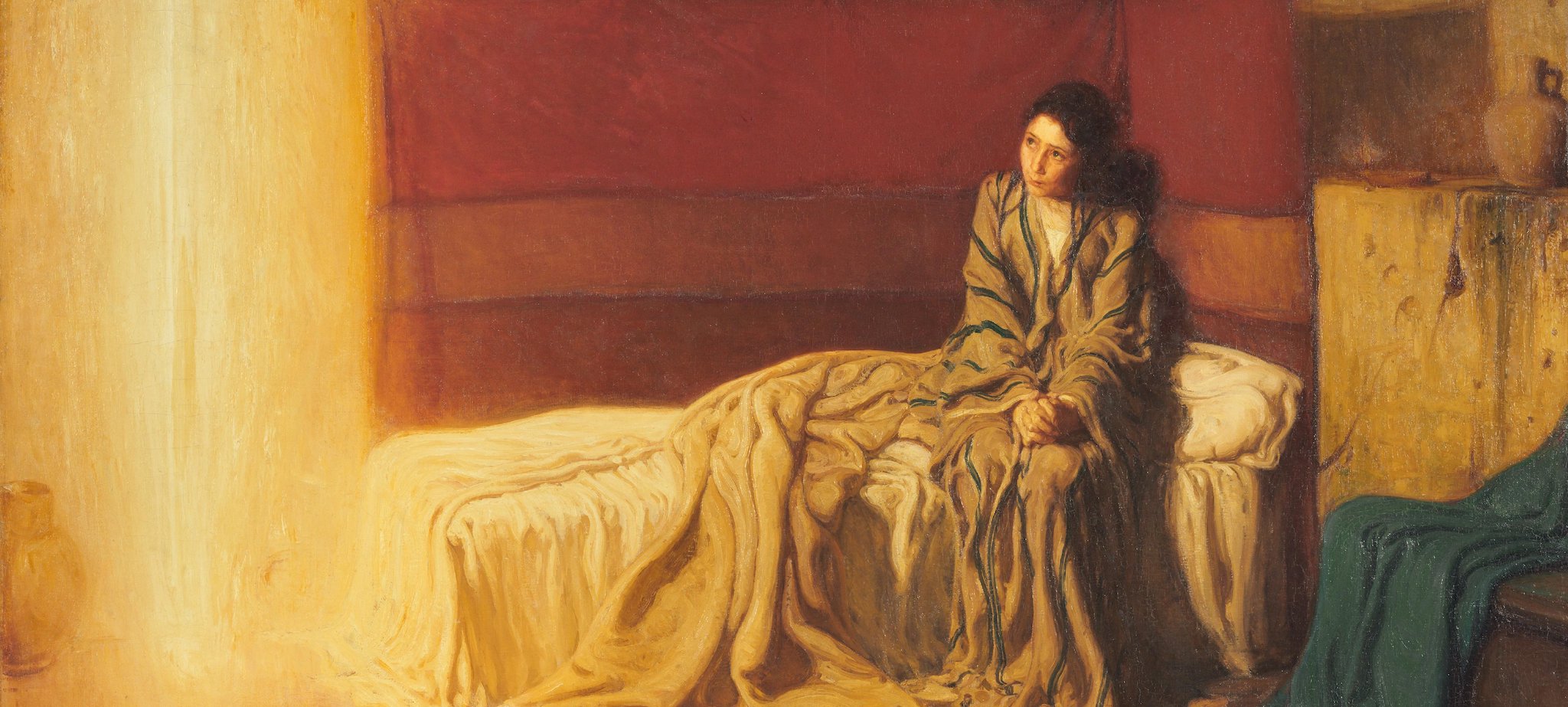
Henry Ossawa Tanner, Annunciation

In the sixth month the angel Gabriel was sent by God to a town in Galilee called Nazareth, to a virgin engaged to a man whose name was Joseph, of the house of David. The virgin’s name was Mary. And he came to her and said, “Greetings, favored one! The Lord is with you.” But she was much perplexed by his words and pondered what sort of greeting this might be. The angel said to her, “Do not be afraid, Mary, for you have found favor with God. And now, you will conceive in your womb and bear a son, and you will name him Jesus. He will be great and will be called the Son of the Most High, and the Lord God will give to him the throne of his ancestor David. He will reign over the house of Jacob forever, and of his kingdom there will be no end.” Mary said to the angel, “How can this be, since I am a virgin?” The angel said to her, “The Holy Spirit will come upon you, and the power of the Most High will overshadow you; therefore the child to be bornwill be holy; he will be called Son of God. And now, your relative Elizabeth in her old age has also conceived a son, and this is the sixth month for her who was said to be barren. For nothing will be impossible with God.” Then Mary said, “Here am I, the servant of the Lord; let it be with me according to your word.” Then the angel departed from her.

Luke 1:26-38

According to some scholars, Mary was as young as 13 years old when this happened. She was a young, unmarried, ordinary woman.

There was nothing particularly extraordinary about Mary, except that she had the simple faith to say, “God, let it be done to me according to your word.” (Luke 1:38)

Do you have that faith this morning?

Do you have that faith to say to God, “Let it be done to me according to your word?”

God doesn’t call the qualified. He qualifies the called.

He doesn’t choose people who are good enough, strong enough, or wise enough.

God chooses people who are not good enough, who are not strong enough, and who are not wise enough.

He chooses the weak in the world to shame the strong.

He chooses the foolish in the world to shame the wise.

If you feel weak, if you feel foolish, if you don’t know how God can use you, if you don’t know where God is calling you to go next, I’m here to tell you, you don’t need to know. You don’t need to have all the answers. You don’t need to be strong enough, or wise enough, or good enough.

You only need to have the simple, humble faith, to say to God, as Isaiah said, “Here I am, Lord, send me.” (Isaiah 6:8)

Do you have that simple, childlike faith this morning?

If you do, God can use you, to accomplish more than you could ever imagine.

As John Piper once said, “He’s a big God for little people”

Mary and Joseph had each received a promise from an angel that Mary’s child would be the Messiah.

But let’s not forget that they had 9 months of anticipation leading up this moment. And this time had not been easy for them. They had to suffer the shame of having a child out of wedlock – I mean, how are you gonna explain that to your family?

And then, unable to even secure a guest room, they had to lay the child in a manger – a feeding trough for animals.

At this point, they’re probably wondering, “Is this really happening?” The promise had come 9 months ago – that’s a long time! The memories of the angelic visitations are fading in their minds. The reality of laying a child down in a feeding trough is before them. They need to receive some comfort, some reassurance.

That’s what I love about this next part of the story. Picking it up in Luke 2 verse 8:

Now in that same region there were shepherds living in the fields, keeping watch over their flock by night. Then an angel of the Lord stood before them, and the glory of the Lord shone around them, and they were terrified. But the angel said to them, “Do not be afraid, for see, I am bringing you good news of great joy for all the people: to you is born this day in the city of David a Savior, who is the Messiah, the Lord. This will be a sign for you: you will find a child wrapped in bands of cloth and lying in a manger.” And suddenly there was with the angel a multitude of the heavenly host, praising God and saying,

“Glory to God in the highest heaven,
    and on earth peace among those whom he favors!”

When the angels had left them and gone into heaven, the shepherds said to one another, “Let us go now to Bethlehem and see this thing that has taken place, which the Lord has made known to us.” So they went with haste and found Mary and Joseph and the child lying in the manger. When they saw this, they made known what had been told them about this child, and all who heard it were amazed at what the shepherds told them, and Mary treasured all these words and pondered them in her heart. The shepherds returned, glorifying and praising God for all they had heard and seen, just as it had been told them.

Luke 2:8-20
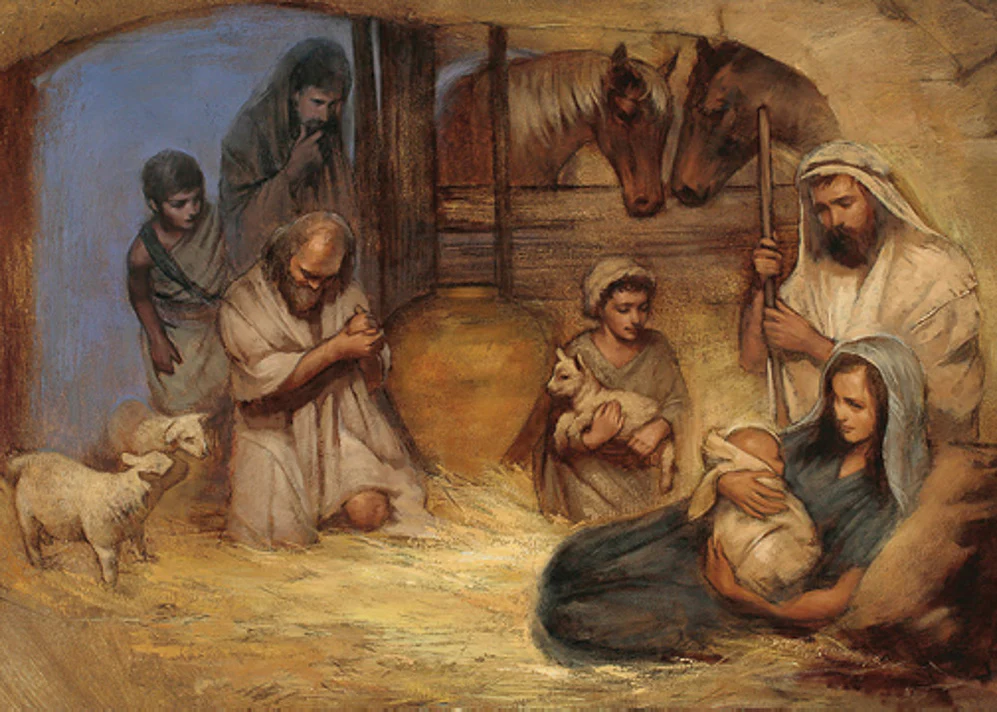
Annie Henrie Nader, Nativity

Can you imagine the comfort and reassurance that Mary and Joseph must have felt when these shepherds showed up just gave them that confirmation: yes, this is really happening. No, you’re not crazy. We saw the angels too! We know that this baby truly is the Messiah.

What overwhelming joy Mary and Joseph must have felt when these shepherds showed up!

Of all the people to be the first to see the Messiah, how great is our God that he would choose shepherds?

Shepherds. Some of the poorest individuals in the ancient world. They were outcasts who lived at the margins of society. Yet, it was these humble shepherds who were the first to see the Christ.

How great is our God? He doesn’t choose the mighty. He doesn’t choose the powerful. He chooses the humble. He chooses the meek.

For the message about the cross is foolishness to those who are perishing, but to us who are being saved it is the power of God. For it is written,

“I will destroy the wisdom of the wise,
    and the discernment of the discerning I will thwart.”

Where is the one who is wise? Where is the scholar? Where is the debater of this age? Has not God made foolish the wisdom of the world? For since, in the wisdom of God, the world did not know God through wisdom, God decided, through the foolishness of the proclamation, to save those who believe. For Jews ask for signs and Greeks desire wisdom, but we proclaim Christ crucified, a stumbling block to Jews and foolishness to gentiles, but to those who are the called, both Jews and Greeks, Christ the power of God and the wisdom of God. For God’s foolishness is wiser than human wisdom, and God’s weakness is stronger than human strength.

Consider your own call, brothers and sisters: not many of you were wise by human standards, not many were powerful, not many were of noble birth. But God chose what is foolish in the world to shame the wise; God chose what is weak in the world to shame the strong; God chose what is low and despised in the world, things that are not, to abolish things that are, so that no one might boast in the presence of God. In contrast, God is why you are in Christ Jesus, who became for us wisdom from God, and righteousness and sanctification and redemption, in order that, as it is written, “Let the one who boasts, boast in the Lord.”

1 Corinthians 1:18-31

I want to close with a poem – the lyrics to a song by Audrey Assad called “Winter Snow”

As you hear these words, consider all of the ways that God could have brought his Son in the world. God could have done it so many different ways. He didn’t need to work through ordinary people like Mary and Joseph. He didn’t need to call shepherds to rejoice.

But consider how much love God has for simple, weak, ordinary, people, that he would choose to work through them.

You could have come like a mighty storm
with all the strength of a hurricane
You could have come like a forest fire
with the power of heaven in your flame

You could have swept in like a tidal wave
or an ocean to ravish our hearts
You could have come through like a roaring flood
to wipe away the things we’ve scarred

But your voice wasn’t in a bush burning
Your voice wasn’t in a rushing wind

It was still, it was small, it was hidden

You came like a winter snow
So quiet
So soft
So slow

  • 0

The Kingdom of God

Matthew 6:31-33 “Do not worry then, saying, ‘What will we eat?’ or ‘What will we drink?’ or ‘What will we wear for clothing?’ For the Gentiles eagerly seek all these things; for your heavenly Father knows that you need all these things. But seek first His kingdom and His righteousness, and all these things will be added to you.”

What is the kingdom of God? Jesus talked about the kingdom of God more than anything else. Surprisingly, he never specifically defined it.

His mostly Jewish audience would have understood the kingdom of God from the Old Testament. Unfortunately, many Christians today do not understand the kingdom of God even though it is the central theme of Christ’s teaching. If we are to seek it first, we must understand what it is, using scripture as our guide.

The Importance of the Kingdom

Matthew 4:17 “From that time Jesus began to preach and say, ‘Repent, for the kingdom of heaven is at hand.’”

From the day he began his ministry until he ascended into heaven, Jesus preached this message everywhere: “Repent, for the Kingdom of God is at hand.” Jesus highly valued the kingdom of God and compared it to a treasure in a field or a pearl of great value that a person would sacrifice everything to obtain (Matthew 13).

Christ’s view of the kingdom of God was deeply eschatological in nature. In places like Matthew 24, Luke 21, and Mark 13, Jesus went into detail about the end of the present age and the beginning of a new, messianic age in which the messiah (meaning “anointed king”) would overthrow the governments of the world and rule as the king over the entire world forever. Almost all of Christ’s parables deal directly with this vision a final judgement that is coming soon to the earth (see Matthew 25:1-13, Matthew 22:1-14, Matthew 25:14-30, Matthew 20:1-16).

The Prophets Envisioned the Kingdom

Daniel 7:13-14 “I kept looking in the night visions, and behold, with the clouds of heaven One like a Son of Man was coming, and He came up to the Ancient of Days and was presented before Him. And to Him was given dominion, glory and a kingdom, that all the peoples, nations and men of every language might serve Him. His dominion is an everlasting dominion which will not pass away; and His kingdom is one Which will not be destroyed.”

Identifying himself as the messiah whom Daniel had prophesied about, Jesus took upon himself the title “Son of Man.” In a verse often quoted at Christmas, Isaiah also prophesied about the messiah receiving a kingdom and power:

Isaiah 9:6 “For a child will be born to us, a son will be given to us; and the government will rest on His shoulders”

The prophets foresaw a coming messianic age in which the messiah would rule over the whole world and establish peace on the earth.

Isaiah 2:4 “And He will judge between the nations, and will render decisions for many peoples; and they will hammer their swords into plowshares and their spears into pruning hooks. Nation will not lift up sword against nation, and never again will they learn war”

Isaiah 60:18 Violence will not be heard again in your land, nor devastation or destruction within your borders; but you will call your walls salvation, and your gates praise.

In this messianic age, there will even be peace in the animal kingdom.

Isaiah 11:6 “And the wolf will dwell with the lamb, and the leopard will lie down with the young goat, and the calf and the young lion and the fatling together; and a little boy will lead them”

Knowledge of God will fill the earth.

Jeremiah 31:34They will not teach again, each man his neighbor and each man his brother, saying, ‘Know the LORD,’ for they will all know Me, from the least of them to the greatest of them,” declares the LORD, “for I will forgive their iniquity, and their sin I will remember no more.”

Habakkuk 2:14 For the earth will be filled with the knowledge of the glory of the Lord, as the waters cover the sea.

Rather than the sun, God himself will be the light of the world.

Isaiah 60:19 “No longer will you have the sun for light by day, nor for brightness will the moon give you light; but you will have the LORD for an everlasting light, and your God for your glory.

Everything Wrong Made Right

Revelation 21:3-4And I heard a loud voice from the throne, saying, ‘Behold, the tabernacle of God is among men, and He will dwell among them, and they shall be His people, and God Himself will be among them, and He will wipe away every tear from their eyes; and there will no longer be any death; there will no longer be any mourning, or crying, or pain; the first things have passed away.'”

Revelation 22:1-5 Then he showed me a river of the water of life, clear as crystal, coming from the throne of God and of the Lamb, in the middle of its street. On either side of the river was the tree of life, bearing twelve kinds of fruit, yielding its fruit every month; and the leaves of the tree were for the healing of the nations. There will no longer be any curse; and the throne of God and of the Lamb will be in it, and His bond-servants will serve Him; they will see His face, and His name will be on their foreheads. And there will no longer be any night; and they will not have need of the light of a lamp nor the light of the sun, because the Lord God will illumine them; and they will reign forever and ever.

We see all of the Old Testament prophesies about the kingdom of God beautifully fulfilled in Revelation 21-22, which is a vision of the age to come when the messiah rules the world. Comparing Revelation 21-22 (the very end of the Bible) to Genesis 1-2 (the very beginning of the Bible), the parallels are amazing. What God originally intended the beginning is what he gets in the end!

In the beginning, God created the earth “very good” (Genesis 1:31). Prior to sin, there was no death, disease, crying, or pain. God dwelled on the earth with man, walking and talking with man in the garden (Genesis 3:8). It was only after they sinned that Adam and Eve hid from God and felt ashamed. Sin caused a separation between God and man. Because of sin, the earth was cursed (Genesis 3:18). This curse affected the whole world and brought about thorns and thistles infesting the ground, disease infecting the world, and unrest in the animal kingdom.

But there’s good news: God has not given up on the earth! He is a God of restoration who has a plan to make what is wrong right. We see in Revelation 21-22 that in the end, God will get what he wanted in the beginning. Sin will be no more, and man’s relationship with God will be fully restored. God will once again dwell on the earth with man – “Behold, the tabernacle of God is among men, and He will dwell among them” (Revelation 21:3b).

The tree of life will be restored (Revelation 22:2) and “there will no longer be any curse” (Revelation 22:3a). In fact, there will be “there will no longer be any death; there will no longer be any mourning, or crying, or pain; the first things have passed away.” (Revelation 21:4b).

The kingdom of God can be summed up in this one simple sentence: Everything wrong with the world made right!

God’s Covenants with Abraham and Isaac

Genesis 12:1-3 “Now the LORD said to Abram, ‘Go forth from your country, and from your relatives and from your father’s house, to the land which I will show you; and I will make you a great nation, and I will bless you, and make your name great; and so you shall be a blessing; and I will bless those who bless you, and the one who curses you I will curse. And in you all the families of the earth will be blessed.”

The story of the kingdom of God begins with Abraham. God called Abraham (originally named Abram) to leave the land in which he was living and travel to the land of Canaan, which God promised to give to Abraham and his descendants forever. From Abraham would come a kingdom that would last forever.

Genesis 13:14-15 “The LORD said to Abram, after Lot had separated from him, ‘Raise your eyes now, and look from the place where you are, northward and southward and eastward and westward; for all the land that you see I will give to you and to your offspring forever.'”

God later extended the territory to include all the land of Cannan.

Genesis 17:8 “And I will give to you, and to your offspring after you, the land where you are now an alien, all the land of Canaan, for a perpetual holding; and I will be their God.”

God’s covenant with Abraham was renewed with Isaac, the son whom God had promised to miraculously give to Abraham in his old age.

Genesis 26:2-5 “The LORD appeared to him and said, “Do not go down to Egypt; stay in the land of which I shall tell you. Sojourn in this land and I will be with you and bless you, for to you and to your descendants I will give all these lands, and I will establish the oath which I swore to your father Abraham. I will multiply your descendants as the stars of heaven, and will give your descendants all these lands; and by your descendants all the nations of the earth shall be blessed; because Abraham obeyed Me and kept My charge, My commandments, My statutes and My laws.”

God’s Covenant With Moses

Isaac’s son Jacob (later renamed Israel) became the father of twelve sons from whom came the twelve tribes of Israel and the “Israelites”. But there were some bumps in the road. The rest of Genesis explains how the Israelites ended up in Egypt rather than Canaan, the land that had been promised to them. In the next book, Exodus, God calls Moses to free the Israelites from slavery in Egypt and lead them to the promised land.

God made a covenant with Moses. If the Israelites kept the commandments, they would possess the land forever and be a kingdom of priests and a holy nation:

Exodus 19:5-6a “Now then, if you will indeed obey My voice and keep My covenant, then you shall be My own possession among all the peoples, for all the earth is Mine; and you shall be to Me a kingdom of priests and a holy nation.”

God’s Covenant With David

The Israelites entered the land and took possession of it. Their first king, Saul, eventually turned away from God. But their next king, David, was “a man after God’s own heart” (1 Samuel 13:14, Acts 13:22). God made a covenant with King David in which he promised that one of David’s descendants would reign as the king over the whole world for all eternity!

2 Samuel 7:12-13 “I will raise up your offspring after you, who shall come from your body, and I will establish his kingdom. He shall build a house for my name, and I will establish the throne of his kingdom forever.”

In Jeremiah 33, God tied this promise to the sun and the moon – as long as the sun and moon continue to rise, this promise can never be broken.

Jeremiah 33:25-26 “Thus says the LORD, ‘If My covenant for day and night stand not, and the fixed patterns of heaven and earth I have not established, then I would reject the descendants of Jacob and David My servant, not taking from his descendants rulers over the descendants of Abraham, Isaac and Jacob. But I will restore their fortunes and will have mercy on them.’”

Bumps in the Road

The Israelites eagerly awaited the promised king who would rule forever. But once again, there were bumps in the road. Israel became divided into a northern kingdom (Israel) and a southern kingdom (Judah). Then, the divided Israel faced serious threats from foreign nations.

First, the Assyrians invaded and conquered the northern kingdom of Israel, which accounted for ten out of the twelve tribes. Then, the Babylonians invaded Judah and took the remaining two tribes into exile in Babylon. At this point, the Temple lay in ruins and the Israelites no longer possessed any of the land.

But God was faithful. In a verse frequently quoted out of context, God promised that the Babylonian captivity would only last for 70 years, and after that, the Israelites would return to the land:

Jeremiah 29:10-11 “For thus says the LORD, ‘When seventy years have been completed for Babylon, I will visit you and fulfill My good word to you, to bring you back to this place. For I know the plans that I have for you,’ declares the LORD, ‘plans for welfare and not for calamity to give you a future and a hope.’”

Sure enough, the Persians conquered Babylon and allowed the Israelites to return to the land of Canaan. But it was a still a rocky road. Under Alexander the Great, the Greek Empire conquered Israel and occupied the land. Under the leadership of Judas Maccabeus, Israel was briefly re-established during the Maccabean Revolt, which is commemorated every year in the celebration of Hanukah. But it didn’t last, and the land eventually fell to the Roman Empire.

The Messiah They Didn’t Expect

At the time of Christ, the land of Israel was under military occupation by the Romans. The Romans were polytheists with no respect for the one true God. Roman soldiers could force Jews into slavery by making them to carry gear for up to one mile.

It is in this historical context – a context of oppression and despair – that the Christmas story takes place. The Jews eagerly awaited the fulfillment of God’s promise to David – the soon coming king who would overthrow the Roman Empire and rule the world forever. This is why Matthew and Luke both open their gospels with long genealogies. They may seem boring to us, but they are actually incredibly exciting because they prove that Jesus is both a descendant of Abraham and a descendant of David, and therefore eligible to fulfill the prophecies.

Jesus identified himself as the Son of Man whom Daniel had prophesied about, but his approach to establishing the kingdom of God was totally opposite of what most people expected. The Jewish zealots were expecting a military leader like Judas Maccabeus who would liberate Israel by military force. Jesus, on the other hand, taught nonviolence: “love your enemies and pray for those who persecute you” (Matthew 5:44). Rather than fighting the Roman soldier who could force you to carry his gear for a mile, Jesus said to carry it for two miles (Matthew 5:41) and if a soldier slaps you on the cheek, “turn the other to him also!” (Matthew 5:39).

The Jews expected the kingdom to be established by military force, but Jesus said: “do not resist an evil person” (Matthew 5:39) and “all those who take up the sword shall perish by the sword” (Matthew 26:52).

Most shockingly of all, Jesus was crucified. To the Jews of that day, it seemed totally unimaginable that the promised king who was supposed to rule the world forever would be executed on a stake. But this had all been prophesied (e.g. Isaiah 53) and was part of God’s plan. Understandably, it was a hard truth to accept. Thus, Paul says in 1 Corinthians 1:23, “we preach Christ crucified: a stumbling block to Jews”.

Sin had to be atoned for so that all people – including non-Jews – could enter the covenant promises that God made to Abraham, Moses, and David. Paul declares in Romans 9-11 that, like wild branches grafted onto an olive tree, we too are now counted as descendants of Abraham through our faith in Jesus Christ. This means that all of the promises God made about the kingdom now apply to us! The kingdom promises are received not through ancestry or ritual (e.g. circumcision) but through faith and love.

Galatians 5:6 ESV “For in Christ Jesus neither circumcision nor uncircumcision counts for anything, but only faith working through love.”

The Kingdom Lifestyle

Luke 6:20-26And turning His gaze toward His disciples, He began to say, ‘Blessed are you who are poor, for yours is the kingdom of God. Blessed are you who hunger now, for you shall be satisfied. Blessed are you who weep now, for you shall laugh. Blessed are you when men hate you, and ostracize you, and insult you, and scorn your name as evil, for the sake of the Son of Man. Be glad in that day and leap for joy, for behold, your reward is great in heaven. For in the same way their fathers used to treat the prophets. But woe to you who are rich, for you are receiving your comfort in full. Woe to you who are well-fed now, for you shall be hungry. Woe to you who laugh now, for you shall mourn and weep. Woe to you when all men speak well of you, for their fathers used to treat the false prophets in the same way.

The ethics of Jesus in the Sermon on the Mount (Matthew 5-7, see also Luke 6) make absolutely no sense, unless you view them in light of the kingdom of God as a soon coming reality.

For Jesus, it was okay to suffer injustice in this present age because he foresaw a soon coming kingdom in which everything about the present world would be flipped upside down. “The last shall be first, and the first last” (Matthew 20:16).

In the present world, it is the rich, the powerful, the popular, and the happy who everyone considers blessed. But in the coming kingdom, the poor, the lowly, the despised, the weeping and mourning, the humble, those hungering and thirsting for justice – these are the ones who are blessed (Matthew 5, Luke 6)!

Jesus began his public teaching with the radical words: “Blessed are the poor… blessed are those who weep… blessed are you when men hate you” (Luke 6:21-22). He foresaw a coming kingdom in which the poor, hungry, and persecuted would receive blessing, but the rich would be “sent away empty” (Luke 1:53).

The ethics of Jesus are directly tied to this vision of the kingdom of God. He will judge his followers on whether they helped the poor and needy: “to the extent that you did it to one of these brothers of Mine, even the least of them, you did it to Me” (see Matthew 25:31-46).

For Jesus, the kingdom of God flips the world upside down.

Mark 9:35b “If anyone wants to be first, he shall be last of all and servant of all”

Mark 10:44 “Whoever wishes to be first among you shall be slave of all”

Count the Cost: The Good News of a Challenging Gospel

The kingdom of God is everything wrong with the world made right. It is good news, but it is also incredibly challenging. It’s good news because there will be no more death, pain, sin, or evil when the kingdom comes. It’s challenging because seeking the kingdom means denying one’s self, taking up one’s cross, and following Christ. This is not a decision to be taken lightly. Jesus warned us to count the cost before we even begin to follow him.

Luke 14:27-33 “Whoever does not carry his own cross and come after Me cannot be My disciple. For which one of you, when he wants to build a tower, does not first sit down and calculate the cost to see if he has enough to complete it? Otherwise, when he has laid a foundation and is not able to finish, all who observe it begin to ridicule him, saying, ‘This man began to build and was not able to finish.’ Or what king, when he sets out to meet another king in battle, will not first sit down and consider whether he is strong enough with ten thousand men to encounter the one coming against him with twenty thousand? Or else, while the other is still far away, he sends a delegation and asks for terms of peace. So then, none of you can be My disciple who does not give up all his own possessions.”

There are many false gospels in the world. We must always stay focused on the true gospel that Jesus preached: “Repent for the kingdom of God is at hand” (Matthew 4:17). Jesus was not introducing a new idea when he preached the gospel. Actually, he preached the same gospel that the Old Testament prophets preached when they foretold of an everlasting Kingdom that will be established on the earth with justice, peace, and righteousness forever.

In a world filled with war and terrorism, we have the hope that a king is coming who will establish peace on the earth forever (Isaiah 2:4). In a world filled with death and sorrow, we have the hope that a king is coming who will throw death into the lake of fire and destroy death and sorrow forever (Revelation 20). We share this message with others through words that tell them about the kingdom of God, and through actions that show people what the kingdom will be like by meeting real needs in the world with the love of Christ. “Let us love, not in word or speech, but in truth and action” (1 John 3:18b).

As ambassadors for Christ (2 Corinthians 5:20) and citizens of heaven (Philippians 3:20) we represent the kingdom to the world by being peacemakers and demonstrating the radically sacrificial love that Jesus demonstrated – we love enemies, turn the other cheek, and forgive the unforgivable (Matthew 5-7). This kind of lifestyle is considered radical in the present day world, but it will be commonplace when the kingdom of God comes. By living it out, we represent the kingdom on the earth until it is fully established in the future and all evil is eliminated.

The kingdom message is both good news, and a serious challenge. It is good news because it promises everything wrong with the world will be made right. It is challenging because it demands repentance and obedience to Christ. In the same way that Jesus warned people to repent before the kingdom comes (Matthew 4:17), we should also preach repentance, “speaking the truth in love” (Epehsians 4:15).

The kingdom message is the gospel. The word “gospel” means “good news”. The gospel message is the message that the kingdom of God is coming, that Jesus – the king of the kingdom – is coming back to rule the world. It’s the hope that anchors our souls (Hebrews 6:19) so we can endure the challenges of this present evil age and shine as lights in a dark world (Philippians 2:15).

  • 0