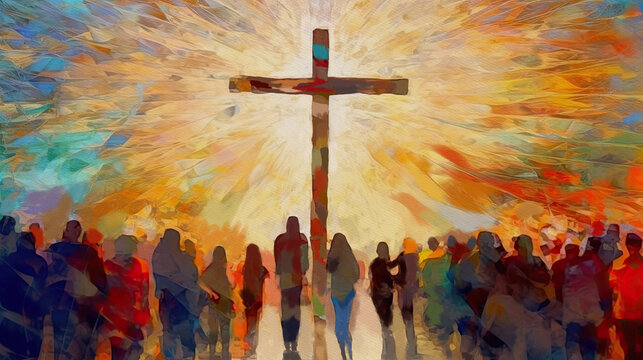
Jesus Died for Your Sins
I was honored to preach this message at the Living Hope International Church on August 9, 2026. Click here for the video recording of my sermon.
Ever since the Russian invasion of Ukraine began, Christian missionaries have been active in Ukraine, often risking their lives to provide life-saving support to widows, orphans, and families in need. One of the efforts that has really ramped up recently, thanks to the work of organizations like the Ukrainian Bible Society, has been getting the Bible into the hands of Ukrainian soldiers on the front lines.
I want to share with you a true story of a Ukrainian soldier who received the gospel of John. He read it, and was struck that Christ claimed to be the only way to God. Jesus said in John 14:6 “I am the way and the truth and the life. No one comes to the Father except through me.”
One day, the young man’s squadron came under an intense Russian attack, and the man was mortally wounded. Medics rushed to his aid, but there was nothing that could be done – he was dying. With his final words, he pleaded with fellow soldiers to look to Jesus Christ. His last words were: “We all need to get right with God.”
In the weeks that followed, his squadron took the dying man’s words to heart. Each and every one of the men in his squadron read the Gospel of John and committed their lives to Christ. Within months, the entire squadron was baptized.
There is a saying that “there are no atheists in a foxhole.” Sooner or later, every person must ask themselves this question: “Am I right with God?” Even the atheist will eventually ask themselves if they are right with the God they don’t believe in. Am I right with God? For many of us, we try to distract ourselves from the question, to avoid thinking about it for as long as possible, until something like a terminal illness, a natural disaster, or God forbid a war, makes the question unavoidable.
To be made right with God is what we call atonement. We read about atonement here in 1 John 2. Now I’m gonna be reading today from the REV Bible, shoutout to Pastor Jerry Wierwille for his help translating this text. So I’m reading from the REV today, buf if you’re reading from any of the standard English Bibles, like the NRSV, NASB, or ESV, what I’m reading should match up very closely with your translation as well.
So we read in 1 John 2:
My little children, I write these things to you so that you will not sin. And if anyone sins, we have an advocate who intercedes for us with the Father—Jesus Christ, the Righteous One. And he is the atoning sacrifice for our sins, and not for ours only, but also for the whole world.
What does “atoning sacrifice” mean?
Put simply, it’s how you are made right with God.
Atonement is defined as “reparation for an offense or injury.” In other words, a payment is made to make right that which was wrong.
Atonement is more than just forgiveness. Let’s say you steal something from me. If I say, “Eh, don’t worry about it. It’s no biggie.” – that’s forgiveness, but it’s not atonement. Atonement means a price is paid to make it right. So if you steal something from me, and then you come to me and say “I’m so sorry, I’m gonna make this right and pay you back 3 times what I took from you.” – that’s atonement.
When atonement happens, the parties that were once at odds with each other are reconciled. If I was mad at you for stealing from me, but you pay it back and make it right, now I’m no longer mad. Our relationship is restored. We go from being at odds with each other – enemies – to now being in right relationship with each other.
The word “atonement” was invented by Bible translator William Tyndale in the early 1530s. He was having trouble translating the Hebrew word kippur into English. Now, you may have heard of this word from the Jewish holiday Yom Kippur also known as the Day of Atonement, and we’re gonna talk about Yom Kippur more in a few minutes. Back in 1530 there wasn’t an English word that communicated the idea of kippur, so Tyndale made one.
He came up with the word by combining 3 words: at-one-ment. In other words, it’s the state of being at one with someone. If you’re “at one” with someone, it means you’re in right relationship with them. Atonement is how we come into a right relationship with God.
Now to understand what it means that Christ is the “atoning sacrifice” for our sins, we need to turn first to the Old Testament. Even though I’m preaching a sermon on how Jesus Christ died for your sins, we’re gonna spend a lot of time in the Old Testament today, and that’s because everything in the Old Testament points to Jesus. To understand the phrase “atoning sacrifice” you need to first understand that atonement is, and then, what a sacrifice is. These are concepts that are first communicated in the Old Testament, and understanding them first from a Hebrew Bible perspective will give us great insight when we finally turn to the New Testament.
So we’re gonna look at 3 concepts from the Old Testament and how each of them points to Jesus Christ as their final and ultimate fulfilment: the passover lamb, the sin offering, and the scapegoat.
First up, the passover lamb. Turn to Exodus 12.
To set the seen, the people of God are in slavery in Egypt, but God has a plan to rescue them out of slavery and bring them to the land he promised to their ancestors. So God raised up a man named Moses to go before Pharaoah the king of Egypt and say, “Let my people go!” Now, most of you know this story. Did Pharoah let the people go? No! Pharaoah did not let the people go.
So God brought 9 plagues upon Egypt, but after each plague, Pharaoah still did not let the people go. So finally, God brought the tenth and worst plague upon Egypt, and this is the plague that would finally convince Pharaoah to free God’s people from slavery.
God sent an angel of death to sweep over the land and kill the firstborn son of every family. But God instructed his people on what they needed to do to protect themselves from the angel of death.
Speak to all the congregation of Israel and say that on the tenth day of this month everyone among them must take a lamb according to their fathers’ houses, a lamb for a household.
And if the household is too little for a lamb, then he and his neighbor near his house are to take one according to the number of people; according to what everyone can eat you are to make your count for the lamb.
Your lamb must be without blemish, a male a year old. You are to take it from the sheep or from the goats,
and you are to keep it safe until the fourteenth day of the same month, and the whole assembly of the congregation of Israel is to slaughter it in the evening.
They must take some of the blood and put it on the two doorposts and on the lintel on the houses in which they will eat it.
-Exodus 12:3-7
And then there are instructions on how to eat it, but if you skip down to verse 12:
For on that night I will go through the land of Egypt and will strike down all the firstborn in the land of Egypt, both man and animal, and against all the gods of Egypt I will execute judgments. I am Yahweh.
The blood will be a sign for you on the houses where you are. And when I see the blood I will pass over you and no plague will be upon you to destroy you when I strike the land of Egypt.
This is why it’s called Passover. When the angel of death saw the blood of the lamb on the doorpost, it would pass overthat house and not strike anyone dead inside that house.
Now, you gotta admit this is weird. Obviously, God wants to strike down the Egyptians, but spare the Israelites. God could have achieved this any number of different ways. He could have said, “Hang a scarlet ribbon from your doorpost and when the angels sees the ribbon he will pass over you.”
Why did it need to be the blood of a lamb? Isn’t that weird?
Stay with me now. Rememeber, everything in the Old Testament symbolizes a future, final fulfilment that’s found in Jesus. So God was very intentional in making sure it would be the blood of a lamb on the doorpost. This has significance that will become more and more clear as we keep going. For now, just remember this simple fact and hold this in your mind:
The blood of the lamb saved the people from death.
We’ll look next at the Guilt Offering. Turn to Leviticus chapter 4 verse 27.
And if one person of the common people sins unintentionally by doing one of the things that Yahweh his God has commanded not to be done, and he becomes guilty,
if his sin which he has sinned is made known to him, then he is to bring for his approach-offering a goat without blemish, a female, for his sin that he has sinned.
He is to lay his hand on the head of the sin offering and slaughter the sin offering at the place of the burnt offering.
The priest is to take some of its blood with his finger and put it on the horns of the altar of burnt offering. And all the rest of its blood he is to pour out at the base of the altar.
He is to remove all its fat, just like the fat is removed from the sacrifice of peace offerings, and the priest is to burn it into smoke on the altar for a pleasing aroma to Yahweh; thus the priest will make atonement for him and he will be forgiven.
Now what is going on here?
At this point in the story, God has led his people out of slavery in Egypt, and they’re on their way to the promised land. But there is sin among the people. Before too long, the people build a golden calf and worship it as their god. And the people commit many other sins, doing what is wrong in God’s eyes. After everything God has done for them – the ten plagues, saving them from death on passover, parting the waters of the Red Sea so they can walk through on dry ground, providing manna to eat in the wilderness, a pillar of cloud by day and a pillar of fire by night, and many other miracles… the people still rebelled, and even wanted to abandon God entirely and return to slavery in Egypt.
This grieved God’s heart. After everything he did for them – love upon love, grace upon grace, miracle upon miracle – the people rejected God.
But God didn’t give up on his people. Because he is a loving and faithful and gracious and forgiving God, he made a way for his people to make amends for the wrongs they had done, and come back into a right relationship with God.
That way is called sacrifice. The idea is this: When a person sins, they take a goat – without spot or blemish – and they bring before the priest. They lay hands on this goat, and they kill it.
The Bible says that “the wages of sin is death.” But God in his grace allows the goat to die, instead of the man.
The goat dies. The man goes free. The payment is made. Right relationship with God is restored.
Why did God set it up this way?
Why did an animal need to die?
Why did it need to be so… bloody?
First of all, sacrifice shows us the seriousness of sin. I think as Christians we take sin too lightly. We believe that we’re forgiven in Christ, so we convince ourselves that sin is no big deal.
I think the Jews understood sin better than we do.
Can you imagine if, every time you sinned, you had to sacrifice an animal?
You would probably sin a lot less, right?
I want to zoom in on this phrase here “he is to lay his hand on the head of the sin offering, and slaughter the sin offering.”
Most scholars agree that this pronoun “he” does not refer to the priest. It refers to the man who sinned.
Can you imagine holding the head of this precious, adorable goat in your hands, then having to take the knife and slit its throat?
God instituted sacrifice as a vivid illustration that makes the seriousness of sin obvious in no uncertain terms. Sin always causes death – either your death, or the death of a substitute. Sin demands that a price be paid.
Now, many modern Jewish scholars, in an attempt to rationalize this seemingly barbaric ancient practice with modern sensibilities, have tried to lighten this, arguing that goat wasn’t really a substitutionary atonement, it was just a symbolic temple system that God gave so they wouldn’t follow the temple systems of the idolatrous nations surrounding them.
But the consensus of ancient and medieval Jewish commentators contradicts this, arguing that the sacrifice was indeed substitutionary – the goat died in place of the man.
I want to read to you some of these Jewish commentaries:
Gersonides was a very influential Jewish rabbi who lived 1288-1344, and in his commentary on Leviticius, he writes: “For this reason the laying hands on the animal was [instituted] to indicate that it is as if he has removed those iniquities from upon himself and transferred them onto the head of that animal…”
Why did the man need to lay his hands on the head of the animal? Because it’s as if the guilt of the man is transferred to the animal. The man was guilty. The animal was innocent. The man deserved to die for his sins, but what should have happened to the man, happened to the animal instead. The animal died in place of the man. This is called substitutionary atonement.
Nachmanides was a very influential Jewish rabbi who lived 1194-1270, and he writes, “he has sinned against his God with his body and his soul and deserves to have his blood spilled and his body burned, were it not for the kindness of the Creator who took a substitute from him…”
Again, I think the meaning here is very clear. The consequence of sin is death, but a substitute dies in our place.
It’s as if you’re guilty of a crime, you’re convicted, you’re sentenced to death, you’re on death row awaiting your execution.
But then, all of a sudden, an innocent person steps in, and says, “Take me instead.”
They die. You go free.
That’s the concept here that God is establishing, way back in Levitcus. That’s grace.
And people think the Old Testament doesn’t have grace! But it does. Everything in the Old Testament points towards its ultimate fulfilment in the New Testament.
Last one. Ovadia ben Jacob Sforno. 1470-1550. He writes, “And he shall lean his hand upon his offering as one who prostrates himself and prays that his iniquity be upon the head of the sacrifice, as in the matter of the scapegoat that is sent away; and by this he will bring forth into some act of humility the thought of repentance which is in his heart, and it shall be accepted for him to atone for him.”
It’s important to point out that this was not a magic formula. Without faith in your heart and genuine repentance, simply going through the motions of a religious ritual has no benefit.
Indeed, there are places in the Old Testament where God basically says, “I’m sick and tired of your sacrifices because you’re just going through the motions and not doing them with a genuine heart of repentance!”
God set up this system of sacrifice to help the people understand the seriousness of sin, to have humility, and to encourage them to repent.
Notice how Sforno references the scapegoat here. That brings us to the last thing in the Old Testament that I want to look at before we turn to the New. The scapegoat.
Turn to Leviticus 16:1.
And Yahweh said to Moses, “Tell Aaron your brother not to come at any time he wants to into the Holy place inside the veil that is in front of the atonement-cover that is on the ark, so that he does not die; for I will appear in the cloud over the atonement-cover.
Now just to give some content, God has already instructed the Israelites to build a tabernacle, which is a portable temple that travelled with them in the wilderness on their way to the promised land. Once they reached the promised land, eventually they build a permament temple. But whether tabernacle or temple, the basic structure was the same:
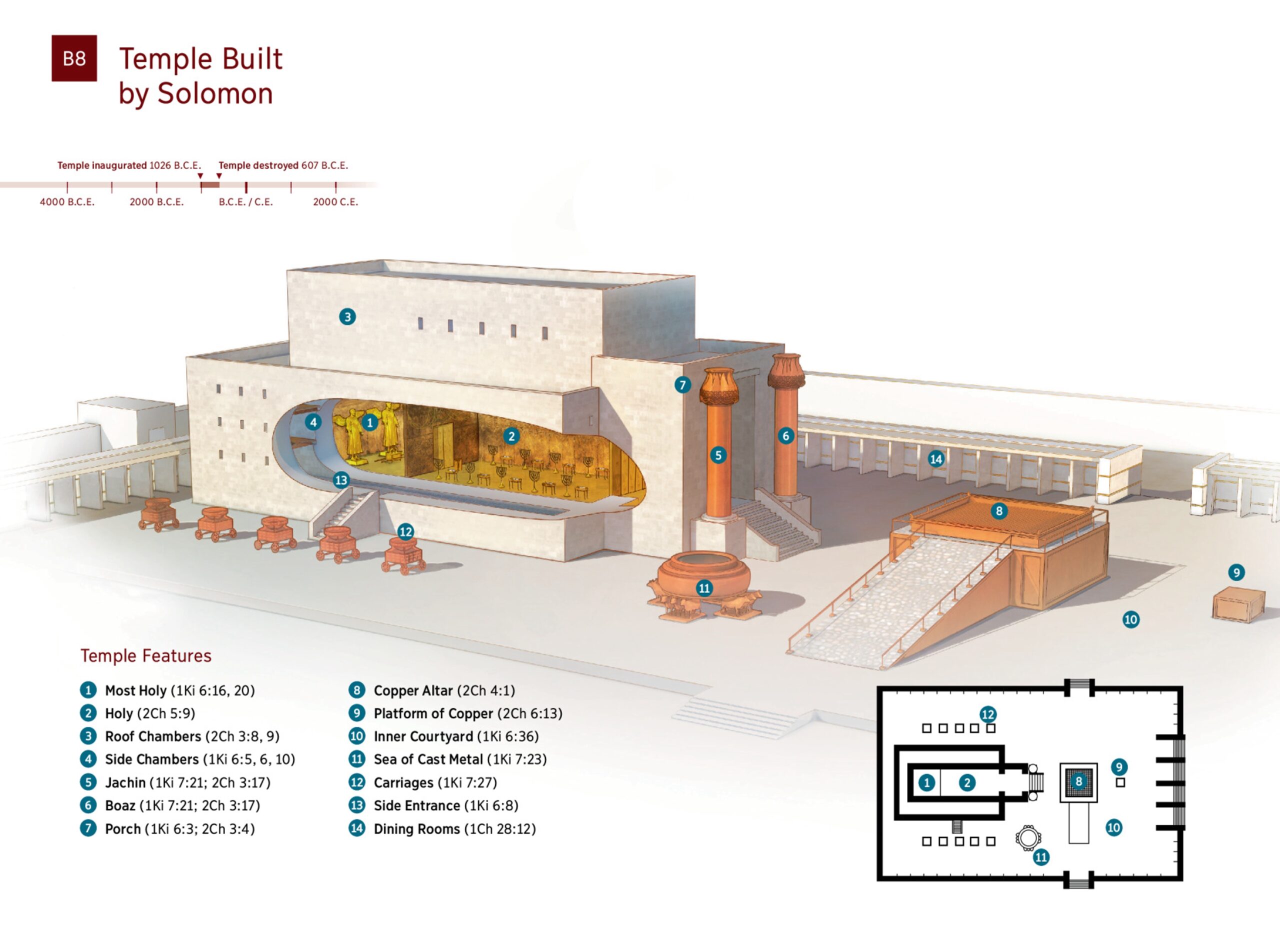
This is an artist’s rendering of the first Jewish temple.
You see outside the temple an altar on a raised platform. This is where animals were sacrified.
You see also a large basin of water. This is where priests would ritually wash themselves before entering the temple.
Inside the temple you have the Holy Place. This contained a golden lampstand called a menorah, a table with fresh bread called the bread of the presence, and the altar of incense.
Only the priests descended from Aaron could enter the Holy Place. It was magnificent. Beautifully decorated with gold and gemstones. Filled with the fragrance of bread and incense.
A thick curtain separated the Holy Place from the Most Holy Place. The Most Holy Place was the chamber that housed the Ark of the Covenant, where the very presence of God dwelled.
No one was allowed to enter the Most Holy Place except for the High Priest, and even he could only enter it once per year – on Yom Kippur, the Day of Atonement.
Because God is holy, and we are not, God gave meticulous instructions on how the high priest was to prepare himself for coming into God’s presence.
You just waltz into the Most Holy Place and say, “Yo, whatup God?”
No. If you are going to come into the presence of a holy God, you do it on his terms.
“Instead, this is how Aaron is to come into the Holy place: with a young bull for a sin offering and a ram for a burnt offering.
He is to put on the holy linen tunic and he is to have the linen undergarments upon his body, and is to put on the linen sash, and he is to be clothed with the linen turban. They are the holy garments. He is to bathe his body in water and put them on.
He is to take from the congregation of the children of Israel two male goats for a sin offering and one ram for a burnt offering.
“Aaron is to offer the bull for the sin offering that is for himself, and make atonement for himself and for his house.
He is to take the two male goats and set them before Yahweh at the entrance of the Tent of Meeting.
Aaron is to place lots upon the two goats: one lot “for Yahweh” and the other lot “for Azazel.”
Aaron is to bring the goat on which the lot came up for Yahweh and offer him as a sin offering.
But the goat on which the lot came up for Azazel is to be left standing alive before Yahweh to make atonement by means of it, to send it away to Azazel into the wilderness.
-Leviticus 16:3-10
This is where we get the word scapegoat.
A scapegoat is defined as: “someone who is blamed for the wrongdoing of others.”
The goat did nothing wrong, but it bears the blame for the people’s sins.
Before sending this goat out into the wilderness, the high priest would place his hands upon the head of the goat, just like with the guilt offering, and he would confess to the goat all the sins of the people.
It’s as if the guilt of the people were being transferred onto this goat. And then when the goat is sent out into the wilderness, it carries away the sins of the people.
This is how atonement worked in the Old Testament.
But God always spoke through the prophets promising that one day a Messiah would come – one who would atone for all sin for all time, bringing all of humanity into a right relationship with God, making everything wrong with the world right.
How would he do this?
Turn to Isaiah 52 – 53:7
Behold, my servant will act wisely. He will be high and lifted up and exalted.
Just as many were appalled at you (his appearance was marred beyond human resemblance, and his form beyond that of human beings),
so he will sprinkle many nations. Kings will shut their mouths on account of him, for they will see what had not been told to them, and what they had not heard they will understand.
Who has believed what we have heard? To whom has the arm of Yahweh been revealed?
For he grows up before him as a young plant and as a root out of dry ground. He has no good looks or majesty. When we see him, there is no beauty that we should be attracted to him.
He is despised and rejected by people; a man of suffering, and one who knew sickness. Like one from whom men hide their faces, he is despised and we did not respect him.
Surely he has borne our sickness and has carried our suffering, yet we have considered him plagued, struck by God, and afflicted.
But he was pierced for our transgressions, was crushed for our iniquities. The punishment that brought us peace was on him, and by his wounds we are healed.
We all like sheep have gone astray. Everyone has turned to his own way, but Yahweh has laid on him the iniquity of us all.
He was oppressed, yet he suffered willingly, and he did not open his mouth. As a lamb that is led to the slaughter and as a sheep that before its shearers is mute, so he did not open his mouth.
and skip down to Isaiah 53:10.
Yet it was the will of Yahweh to crush him. He has caused him to suffer. If his soul makes itself a guilt offering, then he will see his seed. He will prolong his days, and the will of Yahweh will succeed in his hand.
See, everything in the Old Testament, from the Passover Lamb, to the guilt offering, to the scapegoat… it was all merely a shadow of the greater fulfilment to come. It all pointed towards the final and ultimate atonement accomplished by the Messiah, God’s servant and Son.
Just as the passover lamb saved God’s people from death, this Messiah saves us from death.
Just as the guilt offering atoned for sin, the Messiah offered up his own body as the lamb, and became a sin offering for all people for all time. A perfect man who did nothing wrong, died so that people who have done wrong – people like you and me – could be forgiven. He was pierced for our transgressions. Crushed for our iniquities.
Just as the priest would lay his hands on the scapegoat, and the sins of people would be transferred to the scapegoat, and carried by the goat off into the wilderness… just like that this Messiah carried our sins in his body. It says “he bore our sickness and carried our suffering.” And the Bible says that because of what this Messiah accomplished, our sins have been carried away “as far as the east is from the west.”
There is no longer animal sacrifice today. There is no longer any need for it. All of those things were merely shadows pointing towards the true, final, ultimate sacrifice that was to come: the sacrifice of Messiah.
One sacrifice to pay for all sins past, present, and future.
One sacrifice to bring the whole world into right relationship with God.
Who is this Messiah? Who is this perfect man? Who is this servant of God? This Savior?
Turn to John 1.
Before this great Messiah came, God prepared the way by sending a man named John. John baptized people for repetence, preparing the people for the Messiah who was coming.
And then, one day, John proclaimed the greatest that had ever been made.
“On the next day he saw Jesus coming to him, and said, “Behold the Lamb of God who takes away the sin of the world!”
-John 1:29
This Lamb of God is Jesus Christ.
The only perfect man. A man who never sinned, but always did what was right. A man who devoted his life to healing the sick, giving sight to the blind, hearing to the deaf, feeding the hungry, setting captives free. A man who even raised the dead back to life.
This man turned the world upside down. The religious and political establishment hated him. This man was teaching people something fresh and powerful and exciting – he was teaching people how to know God personally, to call him Father, to be part of God’s family, to have not only the promise of eternal life, but purpose and joy and peace in this life as well.
They couldn’t find anything wrong with this man – he had never done anything wrong.
But they arrested him anyway. They brutally beat him and dragged him to sham trials where they made up all kinds of slander against him. They spat on him. They whipped him and beat him with rods. They pierced a crown of thorns into his head and mocked him.
They condemned him to death, but they didn’t have the authority to execute him without the approval of the Roman governor, Pontius Pilate. So they dragged him before Pilate for yet another trial.
Turn to Matthew 27:11-26.
Now Jesus stood before the governor, and the governor asked him, saying, “Are you the king of the Jews?” And Jesus said to him, “Yes, it is as you say.”
And when he was accused by the chief priests and elders, he gave no answer.
Then Pilate said to him, “Do you not hear how many things they are testifying against you?”
But he did not answer him with even one word, so the governor was greatly amazed.
Now at the Passover Feast, it was the governor’s custom to release to the crowd one prisoner whom they wanted.
And at that time they had a notorious prisoner called Barabbas.
Therefore when they were gathered together, Pilate said to them, “Whom do you want me to release to you? Barabbas, or Jesus who is called the Messiah?”
For he knew that they had handed him over because of envy.
And while he was sitting on the judgment seat, his wife sent to him, saying, “Have nothing to do with that righteous man, for today I have suffered many things in a dream because of him.”
Now the chief priests and the elders persuaded the crowd to ask for Barabbas and destroy Jesus.
But the governor answered and said to them, “Which of the two do you want me to release to you?” And they said, “Barabbas.”
Pilate said to them, “Then what do you want me to do with Jesus who is called Christ?” They all kept saying, “He should be crucified!”
But he said, “Why? What evil has he done?” But they shouted even louder, saying, “He should be crucified!”
So when Pilate saw that he was accomplishing nothing, but rather that a riot was starting, he took water, and washed his hands in front of the crowd, saying, “I am innocent of this man’s blood; see to it yourselves.”
And all the People answered and said, “His blood be on us and on our children.”
Then he released Barabbas to them, but he flogged Jesus and handed him over to be crucified.
The people chose Barabbas, a violent rebel. The man who had committed violence was set free, and the man who never sinned – who did no violence – died in his place. Even here, at the moment Jesus is condemned to die, we already see substitutionary atonement in action. Brabbas was on death row. He was the one who deserved to die. But he was set free, and Jesus died in his place.
Even more amazing is the fact that the name Barabbas literally means “son of the Father.”
Bar = Son
Abba = Father
Bar-abbas = Son of the Father
Jesus died so that sinners who don’t deserve it could become sons of God the Father.
And even as Jesus was on th his way to the cross, he was already setting free a sinner whose name means “son of the Father.”
That’s grace. That’s overwhelming, mindblowing grace.
So Barabbas went free. And Jesus went to the cross.
But first the Roman soldiders again brutally beat him and flogged him and whipped him.
Then Jesus was forced to carry a heavy wooden cross all the way outside the city and into the wilderness, just like the scapegoat.
All the way to a place called Golgotha, meaning the Place of the Skull. As one point, having been tortured all night long, Jesus was too weak to carry the cross any further, and a man named Simon of Cyrene carried it for him the rest of the way.
And reaching the Place of the Skull, they pierced his hands and feet, nailing his body to the cross, and they lifted him up.
Pierced for our transgressions. Woundeds for our iniquities.
And lest there be any confusion about the significance of what happened here… in John’s gospel he makes very clear that this was at Passover… the Passover lamb was to be slaughtered every year… that year, Jesus’s own body was the lamb… His blood over our homes saves us from death.
And those passing by were hurling insults at him, shaking their heads,
and saying, “The one who claimed he would destroy the temple and rebuild it in three days, save yourself. If you are the Son of God, come down from the cross.”
In the same way the chief priests also, with the experts in the law and elders, mocking him, said,
“He saved others but he is not able to save himself! He is the king of Israel; let him come down now from the cross, and we will believe in him.
He had confidence in God, let God rescue him now if he wants him, since he said ‘I am the Son of God.’”
Even the rebels who were crucified with him were insulting him in the same way.
-Matthew 27:39-44
This whole time, Jesus just remained silent. Just as it said in Isaiah, “like a sheep before its shearers is silent, so he did not open his mouth.”
Now from the sixth hour darkness came over all the land until the ninth hour.i
And about the ninth hour Jesus cried with a loud voice, saying, “Eli, Eli, lama sabachthani?” (that is, “My God, my God, why have you forsaken me?”).j
And some of those standing there, when they heard this, said, “This man is calling for Elijah.”
And immediately one of them ran and took a sponge and filled it with wine vinegar and put it on a stick, and gave him a drink.
But the rest said, “Leave him alone. Let’s see if Elijah comes to save him.”
And Jesus, having cried out again with a loud voice, gave up his spirit.
And Look! The curtain of the sanctuary was torn in two from top to bottom, and the earth was shaken, and the rocks were split.
And the tombs were opened, and many bodies of the holy ones who had fallen asleep were raised
and coming out of the tombs after his resurrection they entered the holy city and appeared to many.
Now the centurion and those who were with him keeping watch over Jesus, when they saw the earthquake and the things that were happening, were greatly afraid, saying, “Truly this was the Son of God.”
–Matthew 27:45-54
Your sin has been atoned for.
Carried away as far as the east is from the west.
The price has been paid.
It is finished.
The veil in the temple was torn!
Now all people can enter into the Holy of Holies – not just the high priest once a year.
Because of what Christ did, sinners like you and me are able to enter into the presence of God.
Now we can know God as our Father. Know him personally. Intimately.
We can be made right with God. Reconciled into his family.
For Christ did not enter into a holy sanctuary made with hands, which is a copy of the true things, but into heaven itself, now to appear before the face of God on our behalf.
Nor did he enter in order to offer himself over and over, like the high priest who enters into the Holy of Holies year after year with blood that is not his own.
since then it would have been necessary for him to have suffered over and over from the foundation of the world. But now he has been revealed once, at the end of the ages, to put away sin by the sacrifice of himself.
And just as it is appointed for a person to die one time, and after that comes the Judgment,
so Christ also, having been offered one time to take away the sins of many, will appear a second time, not to atone for sin, but to save those who eagerly wait for him.
–Hebrews 9:24-28
So we go back to where we started. Remember those last words spoken by a dying soldier: “Are you right with God?”
If you can’t answer that with 100% certainty, you need atonement.
The good news of the gospel is this: atonement is available.
There is nothing you need to do to earn it. It’s already 100% paid for.
It’s a free gift of salvation, but it wasn’t free. It was paid for with a heavy price. Paid for on the cross.
All you need to do is believe that Jesus died for your sins, and commit to follow him.
Make him the Lord of your life, and you can know God as your Father, and have assurance that you are saved and will have eternal life in God’s Kingdom.
Recent Comments