Jesus Died for Your Sins

I was honored to preach this message at the Living Hope International Church on August 9, 2026. Click here for the video recording of my sermon.

Ever since the Russian invasion of Ukraine began, Christian missionaries have been active in Ukraine, often risking their lives to provide life-saving support to widows, orphans, and families in need. One of the efforts that has really ramped up recently, thanks to the work of organizations like the Ukrainian Bible Society, has been getting the Bible into the hands of Ukrainian soldiers on the front lines.

I want to share with you a true story of a Ukrainian soldier who received the gospel of John. He read it, and was struck that Christ claimed to be the only way to God. Jesus said in John 14:6 “I am the way and the truth and the life. No one comes to the Father except through me.”

One day, the young man’s squadron came under an intense Russian attack, and the man was mortally wounded. Medics rushed to his aid, but there was nothing that could be done – he was dying. With his final words, he pleaded with fellow soldiers to look to Jesus Christ. His last words were: “We all need to get right with God.”

In the weeks that followed, his squadron took the dying man’s words to heart. Each and every one of the men in his squadron read the Gospel of John and committed their lives to Christ. Within months, the entire squadron was baptized.

There is a saying that “there are no atheists in a foxhole.” Sooner or later, every person must ask themselves this question: “Am I right with God?” Even the atheist will eventually ask themselves if they are right with the God they don’t believe in. Am I right with God? For many of us, we try to distract ourselves from the question, to avoid thinking about it for as long as possible, until something like a terminal illness, a natural disaster, or God forbid a war, makes the question unavoidable.

To be made right with God is what we call atonement. We read about atonement here in 1 John 2. Now I’m gonna be reading today from the REV Bible, shoutout to Pastor Jerry Wierwille for his help translating this text. So I’m reading from the REV today, buf if you’re reading from any of the standard English Bibles, like the NRSV, NASB, or ESV, what I’m reading should match up very closely with your translation as well.

So we read in 1 John 2:

My little children, I write these things to you so that you will not sin. And if anyone sins, we have an advocate who intercedes for us with the Father—Jesus Christ, the Righteous One.  And he is the atoning sacrifice for our sins, and not for ours only, but also for the whole world.

What does “atoning sacrifice” mean?

Put simply, it’s how you are made right with God.

Atonement is defined as “reparation for an offense or injury.” In other words, a payment is made to make right that which was wrong.

Atonement is more than just forgiveness. Let’s say you steal something from me. If I say, “Eh, don’t worry about it. It’s no biggie.” – that’s forgiveness, but it’s not atonement. Atonement means a price is paid to make it right. So if you steal something from me, and then you come to me and say “I’m so sorry, I’m gonna make this right and pay you back 3 times what I took from you.” – that’s atonement.

When atonement happens, the parties that were once at odds with each other are reconciled. If I was mad at you for stealing from me, but you pay it back and make it right, now I’m no longer mad. Our relationship is restored. We go from being at odds with each other – enemies – to now being in right relationship with each other.

The word “atonement” was invented by Bible translator William Tyndale in the early 1530s. He was having trouble translating the Hebrew word kippur into English. Now, you may have heard of this word from the Jewish holiday Yom Kippur also known as the Day of Atonement, and we’re gonna talk about Yom Kippur more in a few minutes. Back in 1530 there wasn’t an English word that communicated the idea of kippur, so Tyndale made one.

He came up with the word by combining 3 words: at-one-ment. In other words, it’s the state of being at one with someone. If you’re “at one” with someone, it means you’re in right relationship with them. Atonement is how we come into a right relationship with God.

Now to understand what it means that Christ is the “atoning sacrifice” for our sins, we need to turn first to the Old Testament. Even though I’m preaching a sermon on how Jesus Christ died for your sins, we’re gonna spend a lot of time in the Old Testament today, and that’s because everything in the Old Testament points to Jesus. To understand the phrase “atoning sacrifice” you need to first understand that atonement is, and then, what a sacrifice is. These are concepts that are first communicated in the Old Testament, and understanding them first from a Hebrew Bible perspective will give us great insight when we finally turn to the New Testament.

So we’re gonna look at 3 concepts from the Old Testament and how each of them points to Jesus Christ as their final and ultimate fulfilment: the passover lamb, the sin offering, and the scapegoat.

First up, the passover lamb. Turn to Exodus 12.

To set the seen, the people of God are in slavery in Egypt, but God has a plan to rescue them out of slavery and bring them to the land he promised to their ancestors. So God raised up a man named Moses to go before Pharaoah the king of Egypt and say, “Let my people go!” Now, most of you know this story. Did Pharoah let the people go? No! Pharaoah did not let the people go.

So God brought 9 plagues upon Egypt, but after each plague, Pharaoah still did not let the people go. So finally, God brought the tenth and worst plague upon Egypt, and this is the plague that would finally convince Pharaoah to free God’s people from slavery.

God sent an angel of death to sweep over the land and kill the firstborn son of every family. But God instructed his people on what they needed to do to protect themselves from the angel of death.

Speak to all the congregation of Israel and say that on the tenth day of this month everyone among them must take a lamb according to their fathers’ houses, a lamb for a household.

And if the household is too little for a lamb, then he and his neighbor near his house are to take one according to the number of people; according to what everyone can eat you are to make your count for the lamb.

Your lamb must be without blemish, a male a year old. You are to take it from the sheep or from the goats,

and you are to keep it safe until the fourteenth day of the same month, and the whole assembly of the congregation of Israel is to slaughter it in the evening.

They must take some of the blood and put it on the two doorposts and on the lintel on the houses in which they will eat it.

-Exodus 12:3-7

And then there are instructions on how to eat it, but if you skip down to verse 12:

For on that night I will go through the land of Egypt and will strike down all the firstborn in the land of Egypt, both man and animal, and against all the gods of Egypt I will execute judgments. I am Yahweh.

The blood will be a sign for you on the houses where you are. And when I see the blood I will pass over you and no plague will be upon you to destroy you when I strike the land of Egypt.

This is why it’s called Passover. When the angel of death saw the blood of the lamb on the doorpost, it would pass overthat house and not strike anyone dead inside that house.

Now, you gotta admit this is weird. Obviously, God wants to strike down the Egyptians, but spare the Israelites. God could have achieved this any number of different ways. He could have said, “Hang a scarlet ribbon from your doorpost and when the angels sees the ribbon he will pass over you.”

Why did it need to be the blood of a lamb? Isn’t that weird?

Stay with me now. Rememeber, everything in the Old Testament symbolizes a future, final fulfilment that’s found in Jesus. So God was very intentional in making sure it would be the blood of a lamb on the doorpost. This has significance that will become more and more clear as we keep going. For now, just remember this simple fact and hold this in your mind:

 The blood of the lamb saved the people from death.

We’ll look next at the Guilt Offering. Turn to Leviticus chapter 4 verse 27.

And if one person of the common people sins unintentionally by doing one of the things that Yahweh his God has commanded not to be done, and he becomes guilty,

if his sin which he has sinned is made known to him, then he is to bring for his approach-offering a goat without blemish, a female, for his sin that he has sinned.

He is to lay his hand on the head of the sin offering and slaughter the sin offering at the place of the burnt offering.

The priest is to take some of its blood with his finger and put it on the horns of the altar of burnt offering. And all the rest of its blood he is to pour out at the base of the altar.   

He is to remove all its fat, just like the fat is removed from the sacrifice of peace offerings, and the priest is to burn it into smoke on the altar for a pleasing aroma to Yahweh; thus the priest will make atonement for him and he will be forgiven.

Now what is going on here?

At this point in the story, God has led his people out of slavery in Egypt, and they’re on their way to the promised land. But there is sin among the people. Before too long, the people build a golden calf and worship it as their god. And the people commit many other sins, doing what is wrong in God’s eyes. After everything God has done for them – the ten plagues, saving them from death on passover, parting the waters of the Red Sea so they can walk through on dry ground, providing manna to eat in the wilderness, a pillar of cloud by day and a pillar of fire by night, and many other miracles… the people still rebelled, and even wanted to abandon God entirely and return to slavery in Egypt.

This grieved God’s heart. After everything he did for them – love upon love, grace upon grace, miracle upon miracle – the people rejected God.

But God didn’t give up on his people. Because he is a loving and faithful and gracious and forgiving God, he made a way for his people to make amends for the wrongs they had done, and come back into a right relationship with God.

That way is called sacrifice. The idea is this: When a person sins, they take a goat – without spot or blemish – and they bring before the priest. They lay hands on this goat, and they kill it.

The Bible says that “the wages of sin is death.” But God in his grace allows the goat to die, instead of the man.

The goat dies. The man goes free. The payment is made. Right relationship with God is restored.

Why did God set it up this way?

Why did an animal need to die?

Why did it need to be so… bloody?

First of all, sacrifice shows us the seriousness of sin. I think as Christians we take sin too lightly. We believe that we’re forgiven in Christ, so we convince ourselves that sin is no big deal.

I think the Jews understood sin better than we do.

Can you imagine if, every time you sinned, you had to sacrifice an animal?

You would probably sin a lot less, right?

I want to zoom in on this phrase here “he is to lay his hand on the head of the sin offering, and slaughter the sin offering.”

Most scholars agree that this pronoun “he” does not refer to the priest. It refers to the man who sinned.

Can you imagine holding the head of this precious, adorable goat in your hands, then having to take the knife and slit its throat?

God instituted sacrifice as a vivid illustration that makes the seriousness of sin obvious in no uncertain terms. Sin always causes death – either your death, or the death of a substitute. Sin demands that a price be paid.

Now, many modern Jewish scholars, in an attempt to rationalize this seemingly barbaric ancient practice with modern sensibilities, have tried to lighten this, arguing that goat wasn’t really a substitutionary atonement, it was just a symbolic temple system that God gave so they wouldn’t follow the temple systems of the idolatrous nations surrounding them.   

But the consensus of ancient and medieval Jewish commentators contradicts this, arguing that the sacrifice was indeed substitutionary – the goat died in place of the man.

I want to read to you some of these Jewish commentaries:

Gersonides was a very influential Jewish rabbi who lived 1288-1344, and in his commentary on Leviticius, he writes: “For this reason the laying hands on the animal was [instituted] to indicate that it is as if he has removed those iniquities from upon himself and transferred them onto the head of that animal…”

Why did the man need to lay his hands on the head of the animal? Because it’s as if the guilt of the man is transferred to the animal. The man was guilty. The animal was innocent. The man deserved to die for his sins, but what should have happened to the man, happened to the animal instead. The animal died in place of the man. This is called substitutionary atonement.

Nachmanides was a very influential Jewish rabbi who lived 1194-1270, and he writes, “he has sinned against his God with his body and his soul and deserves to have his blood spilled and his body burned, were it not for the kindness of the Creator who took a substitute from him…”

Again, I think the meaning here is very clear. The consequence of sin is death, but a substitute dies in our place.

It’s as if you’re guilty of a crime, you’re convicted, you’re sentenced to death, you’re on death row awaiting your execution.

But then, all of a sudden, an innocent person steps in, and says, “Take me instead.”

They die. You go free.

That’s the concept here that God is establishing, way back in Levitcus. That’s grace.

And people think the Old Testament doesn’t have grace! But it does. Everything in the Old Testament points towards its ultimate fulfilment in the New Testament.

Last one. Ovadia ben Jacob Sforno. 1470-1550. He writes, “And he shall lean his hand upon his offering as one who prostrates himself and prays that his iniquity be upon the head of the sacrifice, as in the matter of the scapegoat that is sent away; and by this he will bring forth into some act of humility the thought of repentance which is in his heart, and it shall be accepted for him to atone for him.”

It’s important to point out that this was not a magic formula. Without faith in your heart and genuine repentance, simply going through the motions of a religious ritual has no benefit. 

Indeed, there are places in the Old Testament where God basically says, “I’m sick and tired of your sacrifices because you’re just going through the motions and not doing them with a genuine heart of repentance!”

God set up this system of sacrifice to help the people understand the seriousness of sin, to have humility, and to encourage them to repent.

Notice how Sforno references the scapegoat here. That brings us to the last thing in the Old Testament that I want to look at before we turn to the New. The scapegoat.

Turn to Leviticus 16:1.

And Yahweh said to Moses, “Tell Aaron your brother not to come at any time he wants to into the Holy place inside the veil that is in front of the atonement-cover that is on the ark, so that he does not die; for I will appear in the cloud over the atonement-cover.

Now just to give some content, God has already instructed the Israelites to build a tabernacle, which is a portable temple that travelled with them in the wilderness on their way to the promised land. Once they reached the promised land, eventually they build a permament temple. But whether tabernacle or temple, the basic structure was the same:
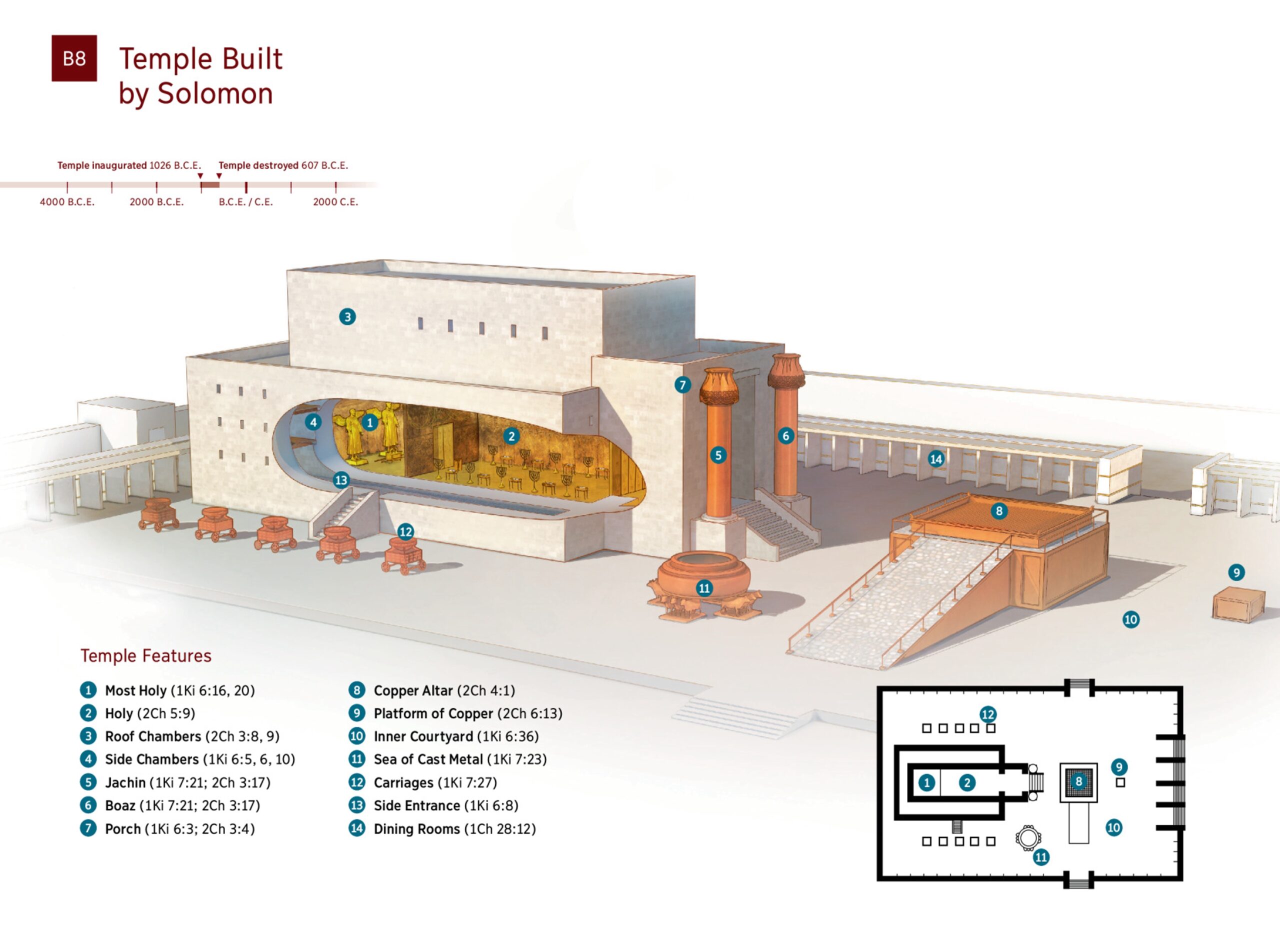
This is an artist’s rendering of the first Jewish temple.

You see outside the temple an altar on a raised platform. This is where animals were sacrified.

You see also a large basin of water. This is where priests would ritually wash themselves before entering the temple.

Inside the temple you have the Holy Place. This contained a golden lampstand called a menorah, a table with fresh bread called the bread of the presence, and the altar of incense.

Only the priests descended from Aaron could enter the Holy Place. It was magnificent. Beautifully decorated with gold and gemstones. Filled with the fragrance of bread and incense.

A thick curtain separated the Holy Place from the Most Holy Place. The Most Holy Place was the chamber that housed the Ark of the Covenant, where the very presence of God dwelled.

No one was allowed to enter the Most Holy Place except for the High Priest, and even he could only enter it once per year – on Yom Kippur, the Day of Atonement.

Because God is holy, and we are not, God gave meticulous instructions on how the high priest was to prepare himself for coming into God’s presence.

You just waltz into the Most Holy Place and say, “Yo, whatup God?”

No. If you are going to come into the presence of a holy God, you do it on his terms.

“Instead, this is how Aaron is to come into the Holy place: with a young bull for a sin offering and a ram for a burnt offering.

He is to put on the holy linen tunic and he is to have the linen undergarments upon his body, and is to put on the linen sash, and he is to be clothed with the linen turban. They are the holy garments. He is to bathe his body in water and put them on.

He is to take from the congregation of the children of Israel two male goats for a sin offering and one ram for a burnt offering.

“Aaron is to offer the bull for the sin offering that is for himself, and make atonement for himself and for his house.

He is to take the two male goats and set them before Yahweh at the entrance of the Tent of Meeting.

Aaron is to place lots upon the two goats: one lot “for Yahweh” and the other lot “for Azazel.”

Aaron is to bring the goat on which the lot came up for Yahweh and offer him as a sin offering.

But the goat on which the lot came up for Azazel is to be left standing alive before Yahweh to make atonement by means of it, to send it away to Azazel into the wilderness.

-Leviticus 16:3-10

This is where we get the word scapegoat.

scapegoat is defined as: “someone who is blamed for the wrongdoing of others.”

The goat did nothing wrong, but it bears the blame for the people’s sins.

Before sending this goat out into the wilderness, the high priest would place his hands upon the head of the goat, just like with the guilt offering, and he would confess to the goat all the sins of the people.

It’s as if the guilt of the people were being transferred onto this goat. And then when the goat is sent out into the wilderness, it carries away the sins of the people.

This is how atonement worked in the Old Testament.

But God always spoke through the prophets promising that one day a Messiah would come – one who would atone for all sin for all time, bringing all of humanity into a right relationship with God, making everything wrong with the world right.

How would he do this?

Turn to Isaiah 52 – 53:7

Behold, my servant will act wisely. He will be high and lifted up and exalted.

Just as many were appalled at you (his appearance was marred beyond human resemblance, and his form beyond that of human beings),

so he will sprinkle many nations. Kings will shut their mouths on account of him, for they will see what had not been told to them, and what they had not heard they will understand.

Who has believed what we have heard? To whom has the arm of Yahweh been revealed?

For he grows up before him as a young plant and as a root out of dry ground. He has no good looks or majesty. When we see him, there is no beauty that we should be attracted to him.

He is despised and rejected by people; a man of suffering, and one who knew sickness. Like one from whom men hide their faces, he is despised and we did not respect him.

Surely he has borne our sickness and has carried our suffering, yet we have considered him plagued, struck by God, and afflicted.

But he was pierced for our transgressions, was crushed for our iniquities. The punishment that brought us peace was on him, and by his wounds we are healed.

We all like sheep have gone astray. Everyone has turned to his own way, but Yahweh has laid on him the iniquity of us all.

He was oppressed, yet he suffered willingly, and he did not open his mouth. As a lamb that is led to the slaughter and as a sheep that before its shearers is mute, so he did not open his mouth.

and skip down to Isaiah 53:10.

Yet it was the will of Yahweh to crush him. He has caused him to suffer. If his soul makes itself a guilt offering, then he will see his seed. He will prolong his days, and the will of Yahweh will succeed in his hand.

See, everything in the Old Testament, from the Passover Lamb, to the guilt offering, to the scapegoat… it was all merely a shadow of the greater fulfilment to come. It all pointed towards the final and ultimate atonement accomplished by the Messiah, God’s servant and Son.

Just as the passover lamb saved God’s people from death, this Messiah saves us from death.

Just as the guilt offering atoned for sin, the Messiah offered up his own body as the lamb, and became a sin offering for all people for all time. A perfect man who did nothing wrong, died so that people who have done wrong – people like you and me – could be forgiven. He was pierced for our transgressions. Crushed for our iniquities.

Just as the priest would lay his hands on the scapegoat, and the sins of people would be transferred to the scapegoat, and carried by the goat off into the wilderness… just like that this Messiah carried our sins in his body. It says “he bore our sickness and carried our suffering.” And the Bible says that because of what this Messiah accomplished, our sins have been carried away “as far as the east is from the west.”

There is no longer animal sacrifice today. There is no longer any need for it. All of those things were merely shadows pointing towards the true, final, ultimate sacrifice that was to come: the sacrifice of Messiah.

One sacrifice to pay for all sins past, present, and future.

One sacrifice to bring the whole world into right relationship with God.

Who is this Messiah? Who is this perfect man? Who is this servant of God? This Savior?

Turn to John 1.

Before this great Messiah came, God prepared the way by sending a man named John. John baptized people for repetence, preparing the people for the Messiah who was coming.

And then, one day, John proclaimed the greatest that had ever been made.

“On the next day he saw Jesus coming to him, and said, “Behold the Lamb of God who takes away the sin of the world!

-John 1:29

This Lamb of God is Jesus Christ.

The only perfect man. A man who never sinned, but always did what was right. A man who devoted his life to healing the sick, giving sight to the blind, hearing to the deaf, feeding the hungry, setting captives free. A man who even raised the dead back to life.

This man turned the world upside down. The religious and political establishment hated him. This man was teaching people something fresh and powerful and exciting – he was teaching people how to know God personally, to call him Father, to be part of God’s family, to have not only the promise of eternal life, but purpose and joy and peace in this life as well.

They couldn’t find anything wrong with this man – he had never done anything wrong.

But they arrested him anyway. They brutally beat him and dragged him to sham trials where they made up all kinds of slander against him. They spat on him. They whipped him and beat him with rods. They pierced a crown of thorns into his head and mocked him.

They condemned him to death, but they didn’t have the authority to execute him without the approval of the Roman governor, Pontius Pilate. So they dragged him before Pilate for yet another trial.

Turn to Matthew 27:11-26.

Now Jesus stood before the governor, and the governor asked him, saying, “Are you the king of the Jews?” And Jesus said to him, “Yes, it is as you say.”

And when he was accused by the chief priests and elders, he gave no answer.

Then Pilate said to him, “Do you not hear how many things they are testifying against you?”

But he did not answer him with even one word, so the governor was greatly amazed.

Now at the Passover Feast, it was the governor’s custom to release to the crowd one prisoner whom they wanted.

And at that time they had a notorious prisoner called Barabbas.

Therefore when they were gathered together, Pilate said to them, “Whom do you want me to release to you? Barabbas, or Jesus who is called the Messiah?”

For he knew that they had handed him over because of envy.

And while he was sitting on the judgment seat, his wife sent to him, saying, “Have nothing to do with that righteous man, for today I have suffered many things in a dream because of him.”

Now the chief priests and the elders persuaded the crowd to ask for Barabbas and destroy Jesus.

But the governor answered and said to them, “Which of the two do you want me to release to you?” And they said, “Barabbas.”

Pilate said to them, “Then what do you want me to do with Jesus who is called Christ?” They all kept saying, “He should be crucified!”

But he said, “Why? What evil has he done?” But they shouted even louder, saying, “He should be crucified!”

So when Pilate saw that he was accomplishing nothing, but rather that a riot was starting, he took water, and washed his hands in front of the crowd, saying, “I am innocent of this man’s blood; see to it yourselves.”

And all the People answered and said, “His blood be on us and on our children.”

Then he released Barabbas to them, but he flogged Jesus and handed him over to be crucified.

The people chose Barabbas, a violent rebel. The man who had committed violence was set free, and the man who never sinned – who did no violence – died in his place. Even here, at the moment Jesus is condemned to die, we already see substitutionary atonement in action. Brabbas was on death row. He was the one who deserved to die. But he was set free, and Jesus died in his place.

Even more amazing is the fact that the name Barabbas literally means “son of the Father.”

Bar = Son

Abba = Father

Bar-abbas = Son of the Father

Jesus died so that sinners who don’t deserve it could become sons of God the Father.

And even as Jesus was on th his way to the cross, he was already setting free a sinner whose name means “son of the Father.”

That’s grace. That’s overwhelming, mindblowing grace.

So Barabbas went free. And Jesus went to the cross.

But first the Roman soldiders again brutally beat him and flogged him and whipped him.

Then Jesus was forced to carry a heavy wooden cross all the way outside the city and into the wilderness, just like the scapegoat.

All the way to a place called Golgotha, meaning the Place of the Skull. As one point, having been tortured all night long, Jesus was too weak to carry the cross any further, and a man named Simon of Cyrene carried it for him the rest of the way.

And reaching the Place of the Skull, they pierced his hands and feet, nailing his body to the cross, and they lifted him up.

Pierced for our transgressions. Woundeds for our iniquities.

And lest there be any confusion about the significance of what happened here… in John’s gospel he makes very clear that this was at Passover… the Passover lamb was to be slaughtered every year… that year, Jesus’s own body was the lamb… His blood over our homes saves us from death.

And those passing by were hurling insults at him, shaking their heads,

and saying, “The one who claimed he would destroy the temple and rebuild it in three days, save yourself. If you are the Son of God, come down from the cross.”

In the same way the chief priests also, with the experts in the law and elders, mocking him, said,

“He saved others but he is not able to save himself! He is the king of Israel; let him come down now from the cross, and we will believe in him.

He had confidence in God, let God rescue him now if he wants him, since he said ‘I am the Son of God.’”

 Even the rebels who were crucified with him were insulting him in the same way.

-Matthew 27:39-44

This whole time, Jesus just remained silent. Just as it said in Isaiah, “like a sheep before its shearers is silent, so he did not open his mouth.”

Now from the sixth hour darkness came over all the land until the ninth hour.i

And about the ninth hour Jesus cried with a loud voice, saying, “Eli, Eli, lama sabachthani?” (that is, “My God, my God, why have you forsaken me?”).j

And some of those standing there, when they heard this, said, “This man is calling for Elijah.”

And immediately one of them ran and took a sponge and filled it with wine vinegar and put it on a stick, and gave him a drink.

But the rest said, “Leave him alone. Let’s see if Elijah comes to save him.”

And Jesus, having cried out again with a loud voice, gave up his spirit.

And Look! The curtain of the sanctuary was torn in two from top to bottom, and the earth was shaken, and the rocks were split.

And the tombs were opened, and many bodies of the holy ones who had fallen asleep were raised

and coming out of the tombs after his resurrection they entered the holy city and appeared to many.

Now the centurion and those who were with him keeping watch over Jesus, when they saw the earthquake and the things that were happening, were greatly afraid, saying, “Truly this was the Son of God.”

Matthew 27:45-54

Your sin has been atoned for.

Carried away as far as the east is from the west.

The price has been paid.

It is finished.

The veil in the temple was torn!

Now all people can enter into the Holy of Holies – not just the high priest once a year.

Because of what Christ did, sinners like you and me are able to enter into the presence of God.

Now we can know God as our Father. Know him personally. Intimately.

We can be made right with God. Reconciled into his family.

For Christ did not enter into a holy sanctuary made with hands, which is a copy of the true things, but into heaven itself, now to appear before the face of God on our behalf.

Nor did he enter in order to offer himself over and over, like the high priest who enters into the Holy of Holies year after year with blood that is not his own.

since then it would have been necessary for him to have suffered over and over from the foundation of the world. But now he has been revealed once, at the end of the ages, to put away sin by the sacrifice of himself.

And just as it is appointed for a person to die one time, and after that comes the Judgment,

so Christ also, having been offered one time to take away the sins of many, will appear a second time, not to atone for sin, but to save those who eagerly wait for him.

Hebrews 9:24-28

So we go back to where we started. Remember those last words spoken by a dying soldier: “Are you right with God?”

If you can’t answer that with 100% certainty, you need atonement.

The good news of the gospel is this: atonement is available.

There is nothing you need to do to earn it. It’s already 100% paid for. 

It’s a free gift of salvation, but it wasn’t free. It was paid for with a heavy price. Paid for on the cross.

All you need to do is believe that Jesus died for your sins, and commit to follow him.

Make him the Lord of your life, and you can know God as your Father, and have assurance that you are saved and will have eternal life in God’s Kingdom.
  • 0

God’s Dream

I was honored to preach this sermon at Living Hope Community Church on July 27, 2025.

What was the message Jesus preached?

Now after John had been taken into custody, Jesus came into Galilee, preaching the gospel of God, and saying, ‘The time is fulfilled, and the kingdom of God is at hand; repent and believe in the gospel.’

-Mark 1:14-15

Jesus was going throughout all Galilee, teaching in their synagogues and proclaiming the gospel of the kingdom, and healing every kind of disease and every kind of sickness among the people.

-Matthew 4:23

Everywhere Jesus went, he preached the gospel of the kingdom of God.

I must preach the kingdom of God to the other cities also, for I was sent for this purpose.

-Luke 4:43

Likewise, Jesus also sent out his disciples to preach the kingdom message.

Soon afterwards, He began going around from one city and village to another, proclaiming and preaching the kingdom of God. The twelve were with Him.

-Luke 8:1

And He sent them out to proclaim the kingdom of God and to perform healing.

-Luke 9:2

The Kingdom of God was the central theme of Jesus’ preaching and ministry, and the central theme of his disciples’ preaching and ministry.

So important was this message of the Kingdom of God, that Jesus said:

This gospel of the kingdom shall be preached in the whole world as a testimony to all the nations, and then the end will come.

-Matthew 24:14

The word “gospel” literally means “good news.”

What is the good news of the kingdom of God?

It’s actually bigger than just something Jesus preached. It’s even bigger than just something the early church preached.

I believe the kingdom of God is the central theme of the entire Bible, from beginning to end.

So important is this theme of the kingdom of God, that every prophet in the Bible – literally every prophet in the Bible – spoke about the kingdom of God in some way.

What is the Kingdom of God?

To understand this central theme of the Bible, you need to understand the story of the Bible and how that story unfolds throughout history, from the creation of the universe, all the way up to the present day, and what will happen in the future.

It’s a story that’s bigger than you, it’s bigger than me, it’s bigger than going to heaven when you die, it’s bigger than anything we can imagine. It’s about the creation of a perfect world, the fall of that world into sin, and God’s perfect plan for redemption and restoration, not only of you as an individual, but of all of creation.

So we’re gonna look at the entire Bible today from cover to cover. Obviously, this is going to be in broad strokes, with many details that we won’t have time to get into. But we’re going back to basics here. The goal today is not to understand every detail of the biblical story, but simply to understand the big picture of scripture – a bird’s eye view, so to speak – so we can grasp the central theme, the main point that scripture is making.

We start at the beginning. Genesis 1:1. And for many of you who are believers, this may be a familiar passage. Every January when you say, “I’m gonna do that ‘read the Bible in one year reading plan’ you open to Genesis 1:1 and you get started,” so many of you have probably read this passage many times. But don’t let the familiarity of it detact from the magnitude of what we are reading. Okay? I want you to read this with open eyes, open minds, viewing this passage in light of the good news of the Kingdom of God, I believe we’re gonna get a deeper understanding.

1 In the beginning God created the heavens and the earth. The earth was formless and void, and darkness was over the surface of the deep, and the Spirit of God was moving over the surface of the waters. Then God said, “Let there be light”; and there was light. God saw that the light was good; and God separated the light from the darkness. God called the light day, and the darkness He called night. And there was evening and there was morning, one day.

Then God said, “Let there be an expanse in the midst of the waters, and let it separate the waters from the waters.” God made the expanse, and separated the waters which were below the expanse from the waters which were above the expanse; and it was so. God called the expanse heaven. And there was evening and there was morning, a second day.

Then God said, “Let the waters below the heavens be gathered into one place, and let the dry land appear”; and it was so. 10 God called the dry land earth, and the gathering of the waters He called seas; and God saw that it was good. 11 Then God said, “Let the earth sprout vegetation, plants yielding seed, and fruit trees on the earth bearing fruit after their kind with seed in them”; and it was so. 12 The earth brought forth vegetation, plants yielding seed after their kind, and trees bearing fruit with seed in them, after their kind; and God saw that it was good. 13 There was evening and there was morning, a third day.

14 Then God said, “Let there be lights in the expanse of the heavens to separate the day from the night, and let them be for signs and for seasons and for days and years; 15 and let them be for lights in the expanse of the heavens to give light on the earth”; and it was so. 16 God made the two great lights, the greater light to govern the day, and the lesser light to govern the night; He made the stars also.

-Genesis 1:1-16

“He made the stars also”. I love how this is just casually mentioned here, almost like an after thought, as if God is so powerful, and making the stars is so insignificant to God, it’s just, “oh yeah he also made the stars… no biggie.”

We’re talking about 100 billion stars – most of them much larger than the sun – just in our galaxy alone. And then our galaxy is just one of upwards of 2 trillion galaxies… so, wait a minute… 100 billion multiplied by 2 trillion. Can anyone do that math? Anyone know what that is?

That’s how many stars God created in just half a verse “yeah, and he made the stars also.” No biggie.

How great, how powerful, how awesome is our God?

How good is our God? Notice what is said after everything God creates: “he saw that it was good.” Over and over again. Good. Good. Good.

God is good. A good God created a good world.

17 God placed them in the expanse of the heavens to give light on the earth, 18 and to govern the day and the night, and to separate the light from the darkness; and God saw that it was good. 19 There was evening and there was morning, a fourth day.

20 Then God said, “Let the waters teem with swarms of living creatures, and let birds fly above the earth in the open expanse of the heavens.” 21 God created the great sea monsters and every living creature that moves, with which the waters swarmed after their kind, and every winged bird after its kind; and God saw that it was good. 22 God blessed them, saying, “Be fruitful and multiply, and fill the waters in the seas, and let birds multiply on the earth.” 23 There was evening and there was morning, a fifth day.

24 Then God said, “Let the earth bring forth living creatures after their kind: cattle and creeping things and beasts of the earth after their kind”; and it was so.25 God made the beasts of the earth after their kind, and the cattle after their kind, and everything that creeps on the ground after its kind; and God saw that it was good.

-Genesis 1:17-25

Now look carefully here at verse 26 and notice how the language changes. Up until now it’s just been God on his own, speaking, and boom, it happens. Pretty simple.

But then, all of a sudden, there’s this moment here where God turns to his angelic court – and we know from the Book of Job chapter 38 verse 7 that the angels were there when God laid the foundations of the earth – God chooses to involve his angels in this next phase of creation. There’s something special about what God is going to create next.

26 Then God said, “Let Us make man in Our image, according to Our likeness; and let them rule over the fish of the sea and over the birds of the sky and over the cattle and over all the earth, and over every creeping thing that creeps on the earth.” 27 God created man in His own image, in the image of God He created him; male and female He created them. 28 God blessed them; and God said to them, “Be fruitful and multiply, and fill the earth, and subdue it; and rule(God is giving man dominion here!) over the fish of the sea and over the birds of the sky and over every living thing that moves on the earth.” 29 Then God said, “Behold, I have given you every plant yielding seed that is on the surface of all the earth, and every tree which has fruit yielding seed; it shall be food for you; 30 and to every beast of the earth and to every bird of the sky and to every thing that moves on the earth which has life, I have given every green plant for food”; and it was so. 31 God saw all that He had made, and behold, it was very good. And there was evening and there was morning, the sixth day.

-Genesis 1:26-31

Turn to the next chapter. Here in chapter 2 we have another version of the creation story that goes into more detail about the creation of human beings.

See, both chapter 1 and chapter 2 are telling a similar story about the creation of the world. But they do it through different lenses.

The point of chapter 1 is that God is all powerful. He speaks, and it’s done. Not only that, but he’s good. And because God is good, he created the world to also be good. No evil. No sin. No pain. No death. God did not intend for there to be any evil in this world. God is good. A good God creates a good world.

Here in chapter 2, we learn another important truth about God. Take a look at verse 7.

It says Then the LORD God…

Now, hold up a second.

Every time that God was referenced in chapter one, it just said “God”. Right?

In the Hebrew, that’s the word Elohim.

But here, it says “the LORD God.” What’s that mean? Why not just say “God”? Why the sudden change?

Notice that it’s a capital L, capital O, capital R, and capital D.

Anytime in the Bible that you see the word LORD in all capital letters, that means that in the Hebrew, it says Yahweh. 

See, Genesis chapter 2 is making a different point than Genesis chapter 1.

While Genesis 1 focuses on God as an omnipotent, unstoppable force that speaks and it is done… Genesis 2 makes the point that this God is not just an impersonal force, but a person… a person who desires a personal, intimate relationship with his connection. This God is relational. This God isn’t just “God”… this God has a personal name.

You don’t need to flip there, but I’ll just put these verses up on the screen… see, thousands of years after Genesis, God revealed more information about his name to Moses.

God spoke further to Moses and said to him, ‘I am the LORD; and I appeared to Abraham, Isaac, and Jacob, as God Almighty, but by My name, LORD, I did not make Myself known to them.’

-Exodus 6:2-3

Abraham is the father of faith. And from him came Isaac, Jacob, and, after many generations, Moses, right? So God is saying to Moses here, “Hey, I appeared to your forefathers. But they just knew me as God. I’m giving you a deeper understanding of myself. I’m revealing to you my personal name.”

Another time when God appeared to Moses, this is at the burning bush when Moses first encountered God… God revealed to Moses more information about his name.

God, furthermore, said to Moses, ‘Thus you shall say to the sons of Israel, ‘The LORD, the God of your fathers, the God of Abraham, the God of Isaac, and the God of Jacob, has sent me to you.’ This is My name forever, and this is My memorial-name to all generations.

-Exodus 3:15

God says that his name, Yahweh, is his name forever, for all generations.

It’s thought that the name Yahweh is related to a Hebrew word meaning “I AM.”

So many things could be said about God. God is love. God is merciful. God is just. God is omniscient, omnipotent, omnipresent.

But the number one most important attribute of God is that he is. He exists. God is. From eternity past to eternity future, God is. He is the existing one. See, everything else in the universe came into existence at a certain time. God is the only one who alwaysis from eternity past to eternity future, no beginning and no end. Everything else in the universe has a beginning and depends on God for its existence. God is the only one who eternally is.

I believe that’s part of what God wants us to understand about himself, as communicated to us through his name.

Now that we have a little bit more understanding about God’s name, let’s turn back to Genesis 2 and see what Genesis 2 is telling us about God:

Then the LORD God formed man of dust from the ground, and breathed into his nostrils the breath of life; and man became a living being.

-Genesis 2:7

How intimate is this moment. Even though God is all powerful, the one who speaks and trillions of stars suddenly explode into existence – one who is infinitely beyond anything we could ever grasp or imagine – nevertheless God wants a relationship with us.

Despite how small and lowly and limited we are, this great and awesome God wants a relationship with us. He stoops down to our level, he meets us in the dust, he gets his hands dirty so to speak – that’s metaphorical, of course, God doesn’t literally have hands – but you understand the point that scripture is making here, is that there’s this intimate connection between God and man right from the beginning.

And notice how beautifully God cares for man:

The LORD God planted a garden toward the east, in Eden; and there He placed the man whom He had formed. 9 Out of the ground the LORD God caused to grow every tree that is pleasing to the sight and good for food; the tree of life also in the midst of the garden, and the tree of the knowledge of good and evil.

-Genesis 2:8-9

Skip to verse 15:

15 Then the LORD God took the man and put him into the garden of Eden to cultivate it and keep it. 16 The LORD  God commanded the man, saying, “From any tree of the garden you may eat freely; 17 but from the tree of the knowledge of good and evil you shall not eat, for in the day that you eat from it you will surely die.”

18 Then the LORD  God said, “It is not good for the man to be alone; I will make him a helper suitable for him.” 19 Out of the ground the LORD  God formed every beast of the field and every bird of the sky, and brought them to the man to see what he would call them; and whatever the man called a living creature, that was its name. 20 The man gave names to all the cattle, and to the birds of the sky, and to every beast of the field, but for Adam there was not found a helper suitable for him. 21 So the LORD  God caused a deep sleep to fall upon the man, and he slept; then He took one of his ribs and closed up the flesh at that place. 22 The LORD  God fashioned into a woman the rib which He had taken from the man, and brought her to the man. 23 The man said,

“This is now bone of my bones,
And flesh of my flesh;
She shall be called Woman,
Because she was taken out of Man.”

24 For this reason a man shall leave his father and his mother, and be joined to his wife; and they shall become one flesh. 25 And the man and his wife were both naked and were not ashamed.

-Genesis 2:15-25

Yahweh is a good God. A good God created a good world. God places the first man and the first woman in a lush, beautiful garden in a very good world – a perfect world – in which all their needs are met, and they experience a perfect relationship with God and each other.

But, God also places in this garden “the tree of the knowledge of good and evil.” Now, they already knew good, so all they could gain from eating from this tree would be evil.

Why is this tree here?

The short answer is, God wants a love relationship with humanity.

1 Corinthians 13:5 says, “love does not insist on its own way.” Another translation says, “love does not demand its own way.”

See, love that is forced is not true love. If I force someone at gunpoint to do something nice for me, they may be doing something nice for me, but it’s not love.

But when love is freely given – when it’s freely chosen, that’s the genuine love that God wants from humanity.

God wants a love relationship with humanity. Therefore, God gave humanity the opportunity to freely choose to love him, or not.

God didn’t force humanity. He made a perfect world – good, good, good, very good. He put them in a perfect garden and supplied every need.

And then, in his great love, God basically said to them, “the choice is yours – you can choose to stay in this loving relationship with me, or you can walk away.”

So this tree is here because God is giving humanity the opportunity to respond to all of the good that he has just done for them. They can now freely choose to respond with love by trusting God, or, to go another way.

Now the serpent was more cunning than any animal of the field which the LORD God had made. And he said to the woman, “Has God really said, ‘You shall not eat from any tree of the garden’?” The woman said to the serpent, “From the fruit of the trees of the garden we may eat; but from the fruit of the tree which is in the middle of the garden, God has said, ‘You shall not eat from it or touch it, or you will die.’” The serpent said to the woman, “You certainly will not die! For God knows that on the day you eat from it your eyes will be opened, and you will become like God, knowing good and evil.” When the woman saw that the tree was good for food, and that it was a delight to the eyes, and that the tree was desirable to make one wise, she took some of its fruit and ate; and she also gave some to her husband with her, and he ate. Then the eyes of both of them were opened, and they knew that they were naked; and they sewed fig leaves together and made themselves waist coverings.

-Genesis 3:1-7

Revelation 12:9 identifies this serpent as “the devil”, “Satan”, and “the one who deceives the whole world.”

Notice the deception of the serpent. “God knows that on the day you eat from it, your eyes will be opened, and you will become like God.”

He made them think that God was keeping something from them, that they were missing out on something.

But the truth is… they were already like God! Entrusted with dominion over the whole world. There was no good thing that God ever withheld from them.

What a lie that Adam and Eve bought into here.

They heard the sound of the LORD God walking in the garden in the cool of the day, and the man and his wife hid themselves from the presence of the LORD God among the trees of the garden. Then the LORD God called to the man, and said to him, “Where are you?” 10 He said, “I heard the sound of You in the garden, and I was afraid because I was naked; so I hid myself.” 11 And He said, “Who told you that you were naked? Have you eaten from the tree of which I commanded you not to eat?” 12 The man said, “The woman whom You gave to be with me, she gave me from the tree, and I ate.” 13 Then the LORD God said to the woman, “What is this you have done?” And the woman said, “The serpent deceived me, and I ate.” 14 The Lord God said to the serpent,

“Because you have done this,
Cursed are you more than all cattle,
And more than every beast of the field;
On your belly you will go,
And dust you will eat
All the days of your life;
15 And I will put enmity
Between you and the woman,
And between your seed and her seed;
He shall bruise you on the head,
And you shall bruise him on the heel.”
16 To the woman He said,
“I will greatly multiply
Your pain in childbirth,
In pain you will bring forth children;
Yet your desire will be for your husband,
And he will rule over you.”

17 Then to Adam He said, “Because you have listened to the voice of your wife, and have eaten from the tree about which I commanded you, saying, ‘You shall not eat from it’;

Cursed is the ground because of you;
In toil you will eat of it
All the days of your life.
18 “Both thorns and thistles it shall grow for you;
And you will eat the plants of the field;
19 By the sweat of your face
You will eat bread,
Till you return to the ground,
Because from it you were taken;
For you are dust,
And to dust you shall return.”

20 Now the man called his wife’s name Eve, because she was the mother of all the living. 21 The LORD God made garments of skin for Adam and his wife, and clothed them.

22 Then the LORD God said, “Behold, the man has become like one of Us, knowing good and evil; and now, he might stretch out his hand, and take also from the tree of life, and eat, and live forever”— 23 therefore the Lord God sent him out from the garden of Eden, to cultivate the ground from which he was taken.

-Genesis 3:8-23

The world was good, good, good, very good.

But Adam and Eve surrendered all of that, for a lie.

Immediately, the effects of sin are present. What are the effects of sin here?

  • Pain in childbirth (v. 16)
  • What about, conflict between men and women? (v. 16) “Your desire will be for your husband, and he shall rule over you.” There’s debate here about what this verse means. This translation, NASB, says “your desire will be for your husband.” The ESV says “your desire will be contrary to your husband”. There’s also debate over whether the “he shall rule over you” is prescriptive or descriptive. In other words, whether God is placing man in a position of greater authority than the woman, or whether God is merely describing what will inevitably happen because of sin – that God didn’t intend for man to rule over woman, that in the beginning God created man and woman to be equals who work together shoulder to shoulder, but now, because of sin, man will rule over women, contrary to God’s original design, and we have certainly seen how that has played out throughout history. Regardless of how you interpret this verse, I think the point is clear that the relationship between man and woman is not the same after sin, as it was before sin. Before sin, perfect harmony between man and woman. But after sin, tension. Woman’s desire is for her man, but man’s desire is for his work. Sin has caused tension, competition, strife. Sin destroys relationships.
  • The land is cursed (3:17-18), resulting in famine, drought, catastrophic weather.
  • Death (Genesis 3:19)

By the sweat of your face you shall eat bread until you return to the ground, because from it you were taken; for you are dust, and to dust you shall return.

-Genesis 3:19

…the wages of sin is death…

-Romans 6:23a

The soul that sins, it shall die.

-Ezekiel 18:20a

But did you know, there was still one more consequence of sin that was perhaps even worse than death.

Now I know what you’re thinking: “What could possibly be worse than death?”

Consider this: Man lost his relationship with God.

Prior to sin, Adam and Eve walked and talked with God face to face in the garden, in the cool of the day.

After sin, they experienced shame, made clothing to cover their nakedness, hid from God, and blamed God, each other, and the serpent.

What a contrast!

Before sin, a perfect intimate relationship with a loving God.

After sin, all that’s left is shame and blame.

Before sin, God and humanity dwell together on the earth.

After sin, God dwells in heaven, human beings dwell on the earth until they die.

Sin separates us from God.

But God did not give up on us.

God is not responsible for the evil, suffering, and death we experience in the world.

God is a good God. A good God who made a good world.

Man made a free will decision to bring evil into the world. Man did this by believing the serpent – who the Book of Revelation identifies as Satan, the deceiver of the whole world – rather than God. By following what Satan said instead of what God said, man disobeyed God, thus bringing evil into the world.

This is what theologians call the “Fall” of man. We live in a world that is filled with evil and suffering, resulting from the Fall – humankind’s decision to sin, to disobey God, to go another way rather than the perfect, good way that God intended for us.

But the good news is, from the very moment than humanity fell, God already had a plan in place to reconcile humanity back into a right relationship with himself, and to restore the world back to the perfection that God originally intended. We see this foreshadowed in Genesis 3:15, where God promises that a descendant of the woman would one day crush the head of the serpent.

Genesis 3:15 is the what theologians call the protoevangelium, or “first gospel.” It’s the first hint of the good news that God would one day redeem humanity back into a right relationship with himself, and restore the entire world back to the perfection God originally intended.

Thus, completing the four main phases of the biblical story: creation, fall, redemption, restoration.

So we’ve seen how the story begins in Genesis, the first book of the Bible.

Now let’s turn to Revelation, the last book of the Bible, and see how the story ends.

The Book of Revelation gives us a vision of a future day when God will make everything wrong with the world right:

Then I saw a new heaven and a new earth; for the first heaven and the first earth passed away, and there is no longer any sea. And I saw the holy city, new Jerusalem, coming down out of heaven from God, made ready as a bride adorned for her husband. And I heard a loud voice from the throne, saying, “Behold, the tabernacle of God is among men, and He will dwell among them, and they shall be His people, and God Himself will be among them,

-Revelation 21:1-3

Hold up a second. God will dwell among human beings again? Can we just pause for a moment and consider what that means?

This is literally heaven on earth, God dwelling face to face with humanity on a perfect earth… just like Eden!

Sin separated us from God, but in the end, God will restore us into a right relationship with himself.

and He will wipe away every tear from their eyes; and there will no longer be any death; there will no longer be any mourning, or crying, or pain; the first things have passed away.

-Revelation 21:4

Sin brought death into the world, but in the end, God will destroy death forever. No more mourning. No more crying. No more pain. That’s good news!

And He who sits on the throne said, “Behold, I am making all things new.” And He said, “Write, for these words are faithful and true.” Then He said to me, “It is done. I am the Alpha and the Omega, the beginning and the end. I will give to the one who thirsts from the spring of the water of life without cost. He who overcomes will inherit these things, and I will be his God and he will be My son.

-Revelation 21:5-7

Then he showed me a river of the water of life, clear as crystal, coming from the throne of God and of the Lamb, in the middle of its street. On either side of the river was the tree of life…

-Revelation 22:1-2a

Wait. Hold up a second. The tree of life is back! This is a big deal!

Literally the only two times the tree of life ever appears in scripture are: at the very beginning of the Bible, and at the very end.

The tree of life is back, that means no more death. Whoever eats from this tree will live forever.

…bearing twelve kinds of fruit, yielding its fruit every month; and the leaves of the tree were for the healing of the nations. There will no longer be any curse…

-Revelation 22:2b-3a

Wait. Hold up a second.

I just love the way it’s stated here.

This could not be any more bluntly stated: THERE. WILL. NO. LONGER. BE. ANY. CURSE.

PERIOD!

That curse that we just read in Genesis 3? It’s GONE. That’s good news!

…and the throne of God and of the Lamb will be in it, and His bond-servants will serve Him; they will see His face, and His name will be on their foreheads. And there will no longer be any night; and they will not have need of the light of a lamp nor the light of the sun, because the Lord God will illumine them; and they will reign forever and ever.

-Revelation 22:3b-5

When we look at the beginning of the Bible, and at the end, we see this big picture:

What God originally intended in the beginning, he gets in the end.

We see how the story begins, and we see how the story ends. The parallels are incredible.

Tree of life in the beginning. Tree of life in the end.

River flowing out of Eden in the beginning. River of water of life in the end.

God dwelling face to face with man in the beginning. God dwelling face to face with man in the end.

No curse in the beginning. No curse in the end.

Man given dominion over the earth in the beginning. Man’s dominion over the earth restored in the end, “they will reign forever and ever” and man’s right relationship with God is restored.

Wow.

What God originally intended in the beginning, he gets in the end.

This, ladies and gentlemen, is the good news of the kingdom of God.

So much could be said about the kingdom of God. Countless books could be written about it.

But if you had to sum it up in as few words as possible, you could sum it up this way:

“Everything wrong with the world made right.”

The good news of the kingdom of God is that God is a God of restoration. Man messed up the world through sin. But God didn’t give up on the earth. He will restore it!

A kingdom is the rule and reign of a king.

When God placed man on the earth, he entrusted man with dominion over it.

Unfortunately, by choosing to sin, to rebel against God, to disobey God and serve Satan rather than God, man chose to surrender his dominion over to Satan.

That’s why John 12:31 calls Satan “the ruler of this world.” And 2 Corinthians 4:4 calls Satan “the god of this world” and Revelation 12:9 says “he deceives the whole world.”

Right now, Satan is exercising his influence and his dominion over the world. No wonder the world is filled with so much injustice, oppression, war, suffering, and death. God didn’t want any of that! God isn’t responsible for that. We are responsible. Human beings – through our own sinful actions – have allowed Satan to take dominion.

The good news of the kingdom of God, is that a day is coming when God will retake his rightful place as ruler.

See, a “kingdom” is defined as the rule and reign of a king.

And when God rules the world, he will restore the world back to what he originally intended – a perfect paradise with no more death, crying, or pain, in which human beings live in peaceful harmony with God and each other.

That’s good news!

Hebrews 6:19 describes this hope as “the anchor of our souls.” It’s what steadies you, strengthens you, and empowers you to persevere when the storms of life assault you.

But a lot of Christians are weak because they don’t know what their hope is!

Their hope is unclear. It’s wishy washy. It’s ethereal.

They think “I guess I’m just gonna float around on clouds forever. Mabe they’ll be harps. Not sure?”

So when the storms of life assault them, they fall away because their hope isn’t real to them!

But church, we have a real hope that solves real problems in the real world!

It’s not a fairy tale. It’s not wishful thinking. It’s not 

It’s the real world, real people, on a real planet, living in right relationship with God and each other.

It’s real good news – news that’s 100% good, not just “kind of good.”

It’s not God evacuating people up to heaven for eternity because the earth is too far gone.

It’s God coming down and repairing the world – making everything wrong with the world right.

For too many Christians, the world doesn’t listen to our message because they think it’s boring and irrelevant. And the picture the church has often painted of eternal life – floating around in clouds and playing harps – it doesn’t resonate.

But our true hope – the biblical hope – could not be more relevant to the world we live in, even now in the 21st century.

In a world filled with war and violence, we have the hope that a King is coming who will establish peace!

In a world filled with death and sorrow, we have the hope that a King is coming who will throw death into the lake of fire and destroy death and sorrow forever!

But church, we have the privilege of sharing this very real, very relevant, very tangible hope with the world. It’s not a fake hope. It’s not a dead hope. It’s a living hope.

Blessed be the God and Father of our Lord Jesus Christ, who according to His great mercy has caused us to be born again to a living hope through the resurrection of Jesus Christ from the dead.

-1 Peter 1:3

This is God’s dream. Everything wrong with the world made right. Let’s go out and share this living hope with the world!

  • 0